Advertisements
Advertisements
Question
The diagram in Fig shows two forces F1 = 5 N and F2 = 3 N acting at points A and B respectively of a rod pivoted at a point O, such that OA = 2 m and OB = 4 m.
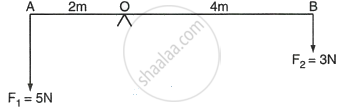
Calculate:
- the moment of force F1 about O.
- the moment of force F2 about O.
- total moment of the two forces about O.
Advertisements
Solution
- Moment of force F1 about O = Force × AO
= 5N × 2m
= 10 Nm (anticlockwise) - Moment of force F2 at O = Force × BO
= 3N × 4m
= 12 Nm (clockwise) - Total moment of force at O
= clockwise moments − anticlockwise moments
= 12 Nm − 10 Nm
= 2 Nm (clockwise)
APPEARS IN
RELATED QUESTIONS
A nut is opened by a wrench of length 20 cm. If the least force required is 2N, find the moment of force needed to loosen the nut.
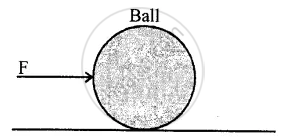
State the effect of force F in of the following diagram.
State one way to decrease the moment of a given force about a given axis of rotation.
Find the moment of force of 20 N about an axis of rotation at distance 0.5 m from the force.
Write an expression for the change in momentum of a body of mass m moving with velocity v if v << c.
The moment of a force about axis depends ______.
Classify the following amongst contact and non-contact forces.
gravitation force
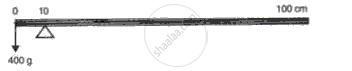
A meter scale is provided at 10 cm mark and is balanced by suspending 400 g from 0 cm mark (fig.). Calculate the mass of meter scale.
Write the expression for calculating the moment of force about a given point.

A uniform metre rule rests horizontally on a knife-edge at the 60 cm mark when a mass of 10 gram is suspended from one end. At which end must this mass be suspended? What is the mass of the rule?
