Advertisements
Advertisements
Question
Two unlike forces (parallel) of 10 N and 25 N act at a distance of 12 cm. from each other. Find the point about which the body balance.
Advertisements
Solution
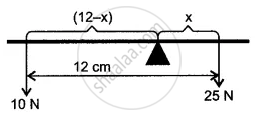
Let the balance be at x cm from the 25 N force.
Anti-clockwise moment = 10 (12 − x)
Clockwise moment = 25 x
Applying the principle of moments,
⇒ 10 (12 − x) = 25 x
⇒ 120 − 10 x = 25 x
⇒ 35 x = 120
⇒ x = `120/35`
= 3.43 cm.
∴ The body balances at the 3.43 cm mark.
RELATED QUESTIONS
Name the factors affecting the turning effect of a body
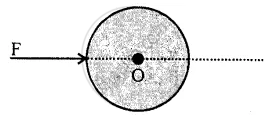
In Fig. a force F is applied in a direction passing through the pivoted point O of the body. Will the body rotate? Give reason to support your answer.
A potter turns his wheel by applying a force through the stick near the rim of wheel.
Calculate the acceleration produced in a body of mass 50 g when acted upon by a force of 20 N.
Two forces each of magnitude 10 N act vertically upwards and downwards respectively at the two ends A and B of a uniform rod of length 4 m which is pivoted at its midpoint O as shown in the figure. Determine the magnitude of the resultant moment of forces about the pivot O.

Classify the following amongst contact and non-contact forces.
electrostatic force
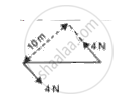
(i) What do you understand by the term couple of forces?
(ii) Calculate the moment of a couple shown in fig.
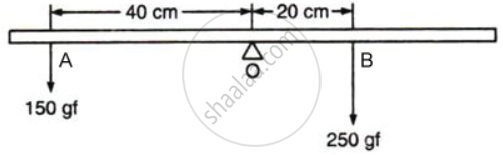
The diagram shows a uniform metre rule weighing 100gf, pivoted at its centre O. Two weights 150gf and 250gf hang from the point A and B respectively of the metre rule such that OA = 40 cm and OB = 20 cm. Calculate :
the total clockwise moment about O
Assertion & Reasoning
- Assertion: The sum of the clockwise moments is equal to the sum of the anticlockwise moments.
- Reason: The principle of conservation of momentum is valid if the external force on the system is zero.
A nut is opened by a wrench of length 25 cm. If the least force required is 10 N, find the moment of force needed to turn the nut.
