Advertisements
Advertisements
Question
Advertisements
Solution
APPEARS IN
RELATED QUESTIONS
A force is applied on (i) a non-rigid body and (ii) a rigid body. How does the effect of the force differ in the above two cases?
A force always produces both the linear and turning motions.
Match the column
| Column A | Column B |
| (a) Camel | (1) broad and deep foundation |
| (b) Truck | (2) broad feet |
| (c) Knife | (3) six or eight tyres |
| (d) High building | (4) sharp cutting edge |
| (e) Thrust | (5) atm |
| (f) Moment of force | (6) N |
| (g) Atmospheric pressure | (7) N m |
To obtain a given moment of force for turning a body, the force needed can be decreased by
Define force.
A nut is opened by a wrench of length 10 cm. if the least force required is 5.0 N. find the moment of force needed to turn the nut.
Two forces each of magnitude 10 N act vertically upwards and downwards respectively at the two ends A and B of a uniform rod of length 4 m which is pivoted at its midpoint O as shown in the figure. Determine the magnitude of the resultant moment of forces about the pivot O.

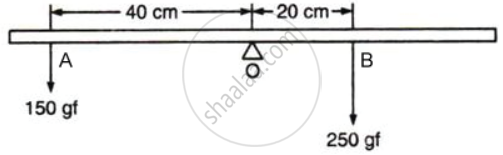
The diagram shows a uniform metre rule weighing 100gf, pivoted at its centre O. Two weights 150gf and 250gf hang from the point A and B respectively of the metre rule such that OA = 40 cm and OB = 20 cm. Calculate :
the total clockwise moment about O
The perpendicular distance between the point of application of force and turning point is 1.75 m when a force of 80 N acts on a rigid body. Calculate the moment of force.
Assertion & Reasoning
- Assertion: The sum of the clockwise moments is equal to the sum of the anticlockwise moments.
- Reason: The principle of conservation of momentum is valid if the external force on the system is zero.
