Advertisements
Advertisements
प्रश्न
How does the effect of force differ when it is applied on a rigid body?
Advertisements
उत्तर
When a force applied on a rigid object it does not change the interspacing of constituent molecules and does not change dimensions and can cause motion in it.
APPEARS IN
संबंधित प्रश्न
An effort is applied on the bigger wheel of a gear having 32 teeth. It is used to turn a wheel of 8 teeth. Where it is used.
Name the factors affecting the turning effect of a body
The spanner (or wrench) has a long handle.
State one way to obtain greater moment of a given force about a given axis of rotation.
The moment of a force of 10 N about a fixed point O is 5 N m. Calculate the distance of the point O from the line of action of the force.
A nut is opened by a wrench of length 10 cm. if the least force required is 5.0 N. find the moment of force needed to turn the nut.
A uniform metre rule of weight 10gf is pivoted at its 0 mark.
What moment of force depresses the rule?
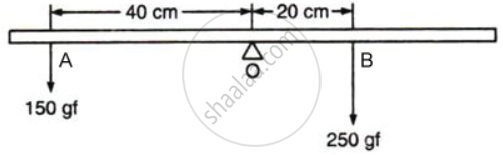
The diagram shows a uniform metre rule weighing 100gf, pivoted at its centre O. Two weights 150gf and 250gf hang from the point A and B respectively of the metre rule such that OA = 40 cm and OB = 20 cm. Calculate :
the total clockwise moment about O
State the units of moment of force.
A uniform metre rule rests horizontally on a knife-edge at the 60 cm mark when a mass of 10 gram is suspended from one end. At which end must this mass be suspended? What is the mass of the rule?
