Advertisements
Advertisements
प्रश्न
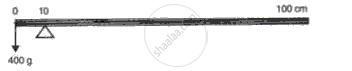
A meter scale is provided at 10 cm mark and is balanced by suspending 400 g from 0 cm mark (fig.). Calculate the mass of meter scale.
Advertisements
उत्तर
Clockwise Moment (due to 400 g at 0 cm)
Moment = 400 × (10 − 0) = 400 × 10 = 4000 g
Anticlockwise Moment (due to weight of scale at 50 cm)
Moment = M × (50 − 10) = M × 40
M × 40 = 4000 ⇒ M = `4000/40`
= 100g
APPEARS IN
संबंधित प्रश्न
What is the SI unit of the moment of force?
Match the column
| Column A | Column B |
| (a) Camel | (1) broad and deep foundation |
| (b) Truck | (2) broad feet |
| (c) Knife | (3) six or eight tyres |
| (d) High building | (4) sharp cutting edge |
| (e) Thrust | (5) atm |
| (f) Moment of force | (6) N |
| (g) Atmospheric pressure | (7) N m |
Classify the following amongst contact and non-contact force.
force of tension in a string
Write the expression for calculating the moment of force about a given axis.
A body is acted upon by two forces of magnitude F but in opposite directions. State the effect of the force if both forces act at the same point of the body.
Define couple.
One joule is the amount of work done when a force of ......... moves a body through a distance of .......
In a beam balance when the beam is balanced in a horizontal position, it is in ________ equilibrium.

A metal rod AB of length 80 cm is balanced at 45 cm from the end A with 100 gf weights suspended from the two ends.
- If this rod is cut at the center, C, then compare the weight of AC to the weight of BC. (Use >, < or =)
- Give a reason for your answer in (a).
