Advertisements
Advertisements
Question
The arms of a beam balance are 20 cm and 21 cm, but the pans are of equal weight. By the method of double weighing the weights are found to be 1000 g and 20 g. Find the actual weight of the body
Advertisements
Solution
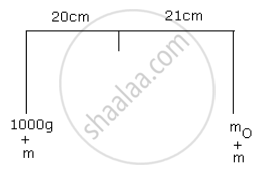
m = mass of each pan
m0 = actual mass of the body
(100 + m)20 = (m + m0) 21
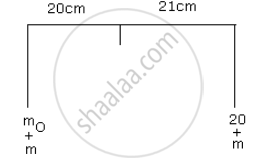
Dividing the two equations
`21/20 = ((100 + "m")20)/((20 + "m") 21)`
1.1 (20 + m) = (1000 + m)
22 + 1.1m = 1000 + m
0.1m = 978
m = 9780g
APPEARS IN
RELATED QUESTIONS
Define equilibrium.
What do you mean by an equilibrium of a body?
A faulty balance of equal arms but pans of unequal weight is used to find the weight of a body. By the method of double weighing the weights are found as 8 kg and 8.2 kg. Find the actual weight of the body.
Explain why It is easier to knock down a boy who is standing on one foot than one who is standing on two.
One end of a spring is kept fixed while the other end is stretched by a force as shown in the diagram.

(i) Copy the diagram and mark on it the direction of the restoring force.
(ii) Name one instrument which works on the above principle.
A boy of mass 30 kg is fitting at a distance of 2 m from the middle of a see-saw. Where should a boy of mass 40 kg sit so as to balance the see-saw?
How can we increase the stability of an object?
Explain the types of stability with suitable examples.
Explain the concept which is used in the continuous movement of the Thanjavur doll?
Give one example of dynamic equilibrium.
