Advertisements
Advertisements
Question
A faulty balance of equal arms but pans of unequal weight is used to find the weight of a body. By the method of double weighing the weights are found as 8 kg and 8.2 kg. Find the actual weight of the body.
Advertisements
Solution

m0= actual weight
mL = weight of leftpan
mR = weight of right pan
mL + 8 = m0 + mR
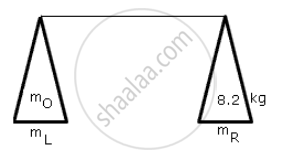
mR + 8.2 kg = m0 + m2
adding the two equations
mL + mR + 16.2kg = 2m0 + m2 +mR
⇒ 16.2 = 2m0
m0 = 8.1 kg
APPEARS IN
RELATED QUESTIONS
In a beam balance, when the beam is balanced in a horizontal position, it is in ______ equilibrium.
What do you mean by an equilibrium of a body?
The figure shows a uniform metre rule placed on a fulcrum at its mid-point O and having a weight 40 gf at the 10 cm mark and a weight of 20 gf at the 90 cm mark.
- Is the metre rule in equilibrium? If not how will the rule turn?
- How can the rule be brought in equilibrium by using an additional weight of 40 gf?

A uniform meter scale is in equilibrium as shown in the diagram :
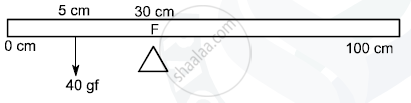
(i) Calculate the weight of the meter scale.
(ii) Which of the following options is correct to keep the ruler in equilibrium when 40 gf wt is shifted to 0 cm mark ?
F is shifted towards 0 cm
or
F is shifted towards 100 cm
A faulty balance of unequal arms and pans of unequal weights is used to find the true weight of a metal. By double weighing the weights are found to be 1210 g and 1000 g. Calculate the true weight of the metal.
Explain when we carry weight, on one hand, we bend on the other side.
What is the weight of a body placed at the centre of the earth?
One end of a spring is kept fixed while the other end is stretched by a force as shown in the diagram.

(i) Copy the diagram and mark on it the direction of the restoring force.
(ii) Name one instrument which works on the above principle.
How can we increase the stability of an object?
What are the three types of stability of an object?
