Advertisements
Advertisements
प्रश्न
A faulty balance of unequal arms and pans of unequal weights is used to find the true weight of a metal. By double weighing the weights are found to be 1210 g and 1000 g. Calculate the true weight of the metal.
Advertisements
उत्तर
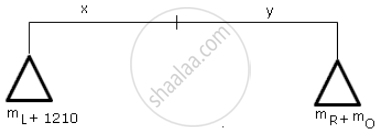

(mL + 1210) x = (mR + mo) y ..............(1)
(mL + m0) x = (mR + 1000) y .............(2)
mL x = mR y ..............(3)
Equations when the two pans are empty from (1)
mL x + 1210 x = mR y + mo y
⇒ 1210 x = mo y ...............(4) (using 3)
from (2)
mL + mo x = mR + 1000 y
⇒ mo x = 1000 y ................(5) (using 3)
dividing equation (4) & (5)
`"m"_"o"/1000 = 1210/"m"_"o"`
⇒ mO = `sqrt (1210 xx1000)` = 1100 g
APPEARS IN
संबंधित प्रश्न
What do you mean by an equilibrium of a body?
State the principle of moments. A meter scale is pivoted at 30 cm mark and it is in equilibrium when a mass of 40 g is suspended from 10 cm mark. Calculate the mass of the ruler.
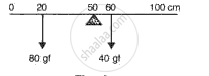
A meter scale is pivoted at its mid point and a 50 g mass suspended from the 20 cm mark. What mass balances the ruler when suspended from 65 cm mark?
Give scientific reason for the following:
In a moving bus the standing passenger stands keeping both his legs apart.
A faulty balance of equal arms but pans of unequal weight is used to find the weight of a body. By the method of double weighing the weights are found as 8 kg and 8.2 kg. Find the actual weight of the body.
In figure, a uniform bar of length l m is supported at its ends and loaded by a weight W kgf at its middle. In equilibrium, find the reactions R1 and R2 at the ends.

`["Hint:" "In equilibrium" "R"_1 + "R"_2 = "W" "and" "R"_1 xx l/2 = "R"_2 xx l/2]`
State the principle of moments.
Explain why It is easier to knock down a boy who is standing on one foot than one who is standing on two.
Mention any two conditions for the stability of a body?
Explain the concept which is used in the continuous movement of the Thanjavur doll?
