Advertisements
Advertisements
प्रश्न
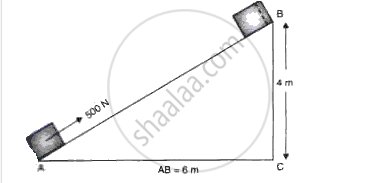
A block of mass 20 kg is pulled up a slope (fig.12) with a constant speed by applying a force of 500 N parallel to the slope. A and B are initial and final positions of the block.
(a) Calculate the work done by the force in moving the block from A and B.
(b) Calculate the potential energy gained by the block.
Advertisements
उत्तर
(a) given force = 500N
Vertical displacement = Final position - initial position = BC = 4m
work done = force x displacement = 500 x 4 = 2000J
(b) P.E gained = mgh = (mg) h = 500 x 4 = 2000J
APPEARS IN
संबंधित प्रश्न
Name a common device where a gear train is used
Work done by a boy depends on the time in which he does work.
The energy of a body is its capacity to do .........
The S.I. unit of work is
A force of 30 N acts on a body and moves it through a distance of 5 m in the direction of force. Calculate the work done by the force.
A person of mass 50 kg climbs a tower of height 72 metres. Calculate the work done. (g = 9.8 m s−2).
A canon ball of mass 500g is fired with a speed of 15m/s-1. Find: its momentum.
A water pump raises 50 kg of water through a height of 25 m in 5s. Calculate the power supplied by the pump (Take: g = 10 N kg−1).
A is a push or a pull ______.
