Advertisements
Advertisements
प्रश्न
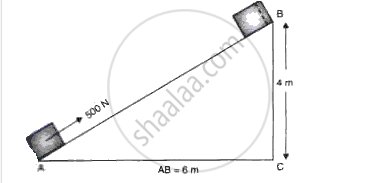
A block of mass 20 kg is pulled up a slope (fig.12) with a constant speed by applying a force of 500 N parallel to the slope. A and B are initial and final positions of the block.
(a) Calculate the work done by the force in moving the block from A and B.
(b) Calculate the potential energy gained by the block.
Advertisements
उत्तर
(a) given force = 500N
Vertical displacement = Final position - initial position = BC = 4m
work done = force x displacement = 500 x 4 = 2000J
(b) P.E gained = mgh = (mg) h = 500 x 4 = 2000J
APPEARS IN
संबंधित प्रश्न
Why is a jack screw provided with a long arm?
Is work a scalar or a vector quantity?
What is the condition for a force to do work on a body?
How many joules are there in 1 mega joule?
A 100 W electric lamp emits energy in the form of light at the rate 10 J per second. What percentage of electric energy does the lamp transform into light energy?
State the amount of work done by an object when it moves in a circular path for one complete rotation. Give a reason to justify your answer.
A truck driver can load oil drums into the back of the truck by pushing them up a sloping plank, or by lifting them directly. Each drum has a mass of 80 kg, the plank is 3 m long, and the back of the truck is 0.8 m above the ground.
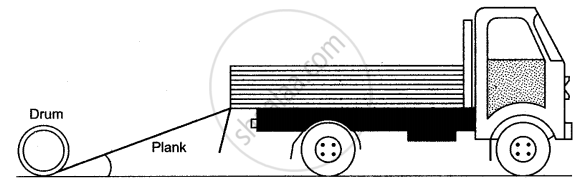
(i) How much force would be needed to lift a drum into the truck directly/without using the plank? (Take g = 10 m/s2)
(ii) How much energy would be required in lifting the drum into the truck without the plank?
(iii) If the force needed to push the drum up the plank is 300 N, why is this less than the answer to part (i)?
(iv) When the truck is loaded, the driver drives off. List the major energy changes that take place in moving the truck.
(v) The driver has to stop at the factory gates. What happens to the kinetic energy of the truck?
Look at the activity below. Reason out whether or not work is done in the light of your understanding of the term ‘work’.
A wind-mill is lifting water from a well.
