Advertisements
Advertisements
Question
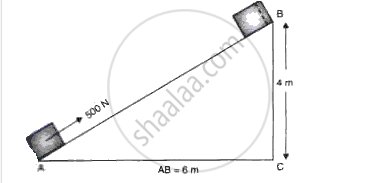
A block of mass 20 kg is pulled up a slope (fig.12) with a constant speed by applying a force of 500 N parallel to the slope. A and B are initial and final positions of the block.
(a) Calculate the work done by the force in moving the block from A and B.
(b) Calculate the potential energy gained by the block.
Advertisements
Solution
(a) given force = 500N
Vertical displacement = Final position - initial position = BC = 4m
work done = force x displacement = 500 x 4 = 2000J
(b) P.E gained = mgh = (mg) h = 500 x 4 = 2000J
APPEARS IN
RELATED QUESTIONS
Define 1 J of work.
The S.I. unit of work is
How is work related to energy?
1 J = ______ calorie.
Find the kinetic energy of a body of mass 1 kg moving with a uniform velocity of 10 m s-1.
Write the formula for the work done on a body when a force acts on the body in the direction of its displacement. Give the meaning of each symbol which occurs in the formula.
P, Q and R are three forces which act as shown in fig.
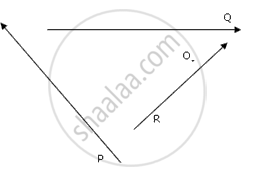
The point O lies in the same plane. Given, P = Q = R = 10N
(i) Which force has the least moment about O? Give a reason.
(ii)Which force has the greatest moment about O? Give a reason.
A man carrying a suitcase in his hand is walking horizontally. What is the work done against gravity?
State the energy changes which take place when A piece of magnesium wire is burnt in a jar of oxygen.
