Advertisements
Advertisements
प्रश्न
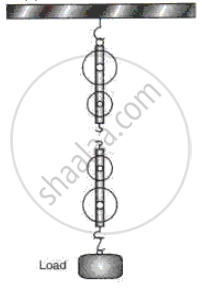
(a) Fig represents an incomplete diagram of a simple string pulley system. Copy this diagram on a new page and complete it and mark where the effort must be applied to lift the load.
(b) What is the velocity ratio of this system?
(c) If the pulley system is 80% efficient and the load is 720 N, then
(i) What effort must be applied to lift the load?
(ii) What work must be done must be done in lifting the load through a distance of 2 m using this machine?
Advertisements
उत्तर
a) Corrert wínding ofrope around pulleys, load and effortis as shown
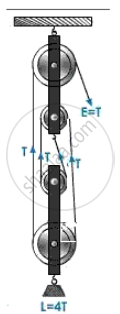
b) Since there are four strings in the block and tackle system, therefore, the velocíty ratio ofthe systemís V.R = n = 4
c)
(i) Given load L = 720 N
Let effort = E
Efficiency = `"M.A"/"V.R"`
or, 80% = `"L/E"/4`
or, `80/100 xx 4 = 720/E`
or, E = `(720 xx 100)/(80 xx 4)` = 225 N
(ii) Given, Load L = 720 N
Displacement - of - load, dL = 2m
Efficiency = `"work - output"/"work - input"`
or work - input = `"work - output"/"efficiency" = ("Load" xx "d"_"L")/"n"`
or, Work - input = `(720 xx 2)/0.8` = 1800 J
APPEARS IN
संबंधित प्रश्न
A pulley system has three pulleys. A load of 120 N is overcome by applying an effort of 50 N. Calculate the Mechanical Advantage and Efficiency of this system.
Answer the following in detail.
How does a pulley make work simpler?
Differentiate between a single fixed pulley and a single movable pulley.
What is a gear system ?
Explain the working of a gear system.
What is a block and tackle system of pulleys?
State two reasons, why the efficiency of a pulley system is not 100 percent?
What is a pulley?
A pulley is a machine made up of a ______.
State one advantage of single movable pulley.
