Advertisements
Advertisements
प्रश्न
What is the use of a fixed pulley?
Advertisements
उत्तर
A fixed pulley is used to change the direction of effort to a convenient direction.
APPEARS IN
संबंधित प्रश्न
From the diagram given below. answer the question that follows:
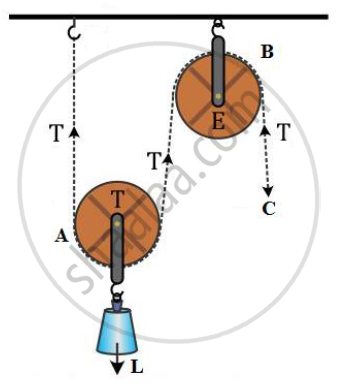
- What kind of pulleys are A and B?
- State the purpose of pulley B.
- What effort has to be applied at C just raise the load L = 20 kgf?
(Neglect the weight of pulley A and friction)
What is the mechanical advantage of an ideal pulley?
The mechanical advantage of an actual pulley is less than one. Give a reason. What is the justification for using the pulley then?
Draw a neat labelled diagram showing a pulley being used to lift a load. How are load and effort related in an ideal situation?
Explain how a gear system can be used to obtain gain in speed? Given one example.
Differentiate between a single fixed pulley and a single movable pulley.
What is a block and tackle system of pulleys?
The diagram below shows a pulley arrangement :
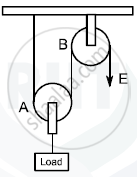
(i) Copy the diagram and mark the direction of tension on each strand of the string.
(ii) What is the velocity ratio of the arrangement ?
(iii) If the tension acting on the string is T, then what is the relationship between T and effort E ?
(iv) If the free end of the string moves through distance x, find the distance by which the load is raised.
There is no gain in mechanical advantage in the case of a single fixed pulley. Explain, why the pulley is then used?
In a single movable pulley system, a load of 125 kgf is lifted by an effort of 75 kgf. Find the percentage efficiency of system.
