Advertisements
Advertisements
प्रश्न
There is no gain in mechanical advantage in the case of a single fixed pulley. Explain, why the pulley is then used?
Advertisements
उत्तर
It is used only to change the direction of effort to a more convenient direction and to use one’s own weight for the effort.
संबंधित प्रश्न
What is the justification for using the pulley then ?
What is a gear system ?
A block and tackle pulley system has a velocity ratio 5. Draw a labelled diagram of this system. In your diagram, indicate clearly the points of application and the directions of the load and effort.
What is the use of a fixed pulley?
Give reason for the following:
In case of a block and tackle system, the mechanical advantage increases with the increase in the number of pulleys.
Fig shown a block and tackles system of pulleys used to lift a load.
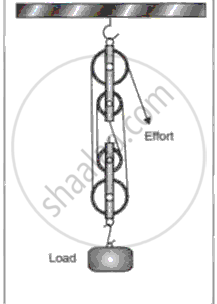
(i) How many strands of tackle are supporting the load?
(ii) Draw arrows to represent tension in each stand.
(iii) What is the mechanical advantage of the system?
(iv) When load is pulled up by a distance 1 m how far does the effort end move?
In the case of a block and tackle arrangement, the mechanical advantage increases with the number of pulleys. Explain.
In a single movable pulley system, a load of 125 kgf is lifted by an effort of 75 kgf. Find the percentage efficiency of system.
A boy lifts a load of 40 kgf through a vertical height of 2m in 5s by using a single fixed pulley when he applies an effort of 48 kgf. Calculate:
(i) the mechanical advantage, and
(ii) the efficiency of the pulley. Why is the efficiency of the pulley is not 100%?
(iii) the energy gained by the load in 5s, and
(iv) the power developed by the boy in raising the load.
Name the type of single pulley that has an ideal mechanical advantage equal to 2. Draw a labelled diagram of the pulley mentioned by you.
