Advertisements
Online Mock Tests
Chapters
![Frank solutions for फिज़िक्स पार्ट [अंग्रेजी] कक्षा १० आईसीएसई chapter 3 - Sound - Shaalaa.com](/images/physics-part-2-english-class-10-icse_6:6e65a815841c4e1d9c2ecbfd294c9e9c.jpg "Frank solutions for फिज़िक्स पार्ट [अंग्रेजी] कक्षा १० आईसीएसई chapter 3 - Sound")
Advertisements
Solutions for Chapter 3: Sound
Below listed, you can find solutions for Chapter 3 of CISCE Frank for फिज़िक्स पार्ट [अंग्रेजी] कक्षा १० आईसीएसई.
Frank solutions for फिज़िक्स पार्ट [अंग्रेजी] कक्षा १० आईसीएसई 3 Sound Activity 3.1 [Pages 174 - 175]
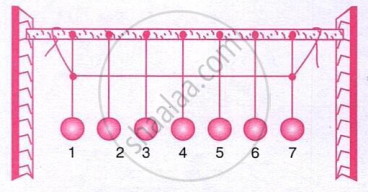
Take a metre scale and suspend 7 simple pendulums on the metre scale in such a way that the pendulums 2, 3, 4, 5 and 6 of equal length are approximately placed equidistant from each other (say 10 cm apart). Keep the pendulums 1 and 7 of bigger length at a slightly longer distance from the pendulums 2 and 6 respectively (say ~11 cm away). Now pass a string at right angles to each of the strings tying firm knots, wherever the string meets each of the seven strings. Get an arrangement of the pendulums as shown in Fig. 2 so that you get pendulums of equal lengths which are placed equidistant from each other.
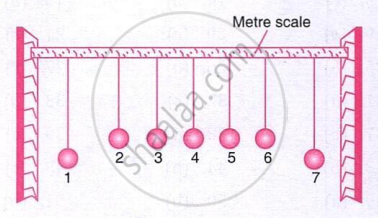
Displace the pendulum 1 to one side so as to set it into oscillations (in a plane perpendicular to the plane of strings) shown in Fig. 2 (Take care that the bobs do not collide as they oscillate.)
Observe the bobs 1 and 2 carefully. What do you see? It will be noticed that gradually the bob 2 picks up oscillation while the bob 1 starts losing until it (bob 1) completely stops oscillating. This process goes on between pendulums 2 and 3, then between 3 and 4 until the last bob starts oscillating. The experiment clearly explains that the oscillation or the disturbance given to the pendulum 1 is passed on to the pendulum 2. The pendulum 2 passes this disturbance to pendulum 3 till it reaches the last pendulum. In other words, the oscillation of the first pendulum passes on to the last pendulum without having come in contact with each other. Such disturbances are called waves.
A wave is defined as a disturbance which travels with finite velocity through a medium and remains unchanged in type as it travels. Waves travel through space or matter. Heat and light rays from the sun travel through space. Sound waves travel through matter (solids, liquids and gases). Sound is also ‘this kind’ of a disturbance or a wave. When you speak, your vocal cords vibrate. These vibrations disturb the air molecules close to your mouth. These in turn disturb their neighbouring molecules. The neighbouring molecules disturb their neighbours and the disturbance is passed on. This disturbance in turn disturbs the molecules close to the listener’s ear and makes them oscillate.
Then these oscillating molecules strike the eardrum and make it vibrate. These vibrations are carried to the brain through nerve connections and the brain decodes these vibrations into sound. Very weak, quiet sounds cannot be heard because the waves do not have enough energy to vibrate the eardrum.
This situation is similar to a convoy of cars (number of cars) regularly spaced, moving along a highway. When the driver of the first car applies brakes, at a traffic signal, all the drivers behind him also do the same. In this case, applying brakes is a disturbance, and it is this disturbance which propagates from the front to the back of the convoy setting up a wave motion.
You can also see the transfer of energy in an arrangement of children standing in a row almost touching each other. Now, give a push to the child in front. You will see that almost every child moves at his or her position, or the disturbance is pushed on. A wave is a means of carrying energy from one place to another. Light rays behave like waves-they carry energy from one place to another. The sun’s rays carry heat energy and light energy from the sun to the earth. Heat rays carry heat energy from an electric heater wire to a cold room. Similarly, sound waves carry sound energy from a source to your eardrums.
The above activities lead us to the definition of wave motion. It is defined as the process by which a disturbance at one point in a medium is propagated to another point, more remote from the source with no net transport of the material of the medium itself.
Frank solutions for फिज़िक्स पार्ट [अंग्रेजी] कक्षा १० आईसीएसई 3 Sound Graded Assignment 3.1 [Pages 185 - 186]
How does the velocity of a wave vary with temperature?
Distinguish between compression and rarefaction.
Give the SI unit of wavelength.
Explain how the principle of echo is used by the bat during its flight at night.
Explain how the principle of echo is used by
The dolphin to locate small fish as its prey
What is 'SONAR'?
State the principle on which SONAR is based.
State whether the following statements is True or False.
Earthquake waves are infrasonic waves.
State whether the following statements is True or False.
SI unit of frequency is ms−1.
State whether the following statements is True or False.
Sound is produced by utilising mechanical energy.
State whether the following statements is True or False.
With rise of air temperature, speed of sound in it decreases.
State whether the following statements is True or False.
Speed of sound is largest in solids.
State whether the following statements is True or False.
The time taken for one complete oscillation in density (or pressure) of the medium is called the time period of the wave.
State whether the following statements is True or False.
The distance between two consecutive compressions (or crests) or two consecutive rarefactions (or troughs) is called the wavelength.
State whether the following statements is True or False.
The distance travelled by a sound wave in its periodic time is also called wavelength of the wave.
State whether the following statements is True or False.
The speed of sound is infinite in solids.
State whether the following statements is True or False.
As sound propagates, it is the sound energy that travels along with the medium itself.
Frank solutions for फिज़िक्स पार्ट [अंग्रेजी] कक्षा १० आईसीएसई 3 Sound Graded Assignment 3.2 [Pages 197 - 198]
What is meant by the natural frequency of vibration of a body?
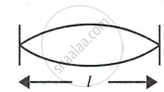
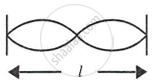
Fig. shows three ways in which a string of length l in an instrument can vibrate.
 |
 |
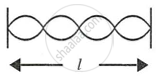 |
| (i) | (ii) | (iii) |
- Which of the diagram shows the principle note?
- Which vibration has the frequency four times that of the first?
- Which vibration is of the longest wavelength?
- What is the ratio of the frequency of the vibration in (i) and (ii)?
When a troop crosses a suspension bridge, the soldiers are asked to break steps. Explain the reason.
How does the medium affect the amplitude of free/natural vibrations of a body?
Is pitch same as frequency?
What adjustments would you make for tuning a stringed instrument for it to emit a note of a desired frequency?
Explain why strings of different thicknesses are provided on a stringed instrument.
[Hint: Natural frequency of vibration of a stretched string is inversely proportional to the radius (or thickness) of string so notes of different frequencies can be produces by vibrating different strings.]
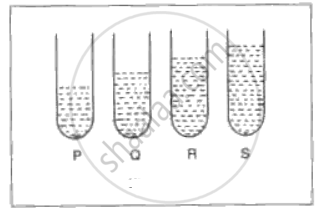
In fig. , P, Q, R and S represent test tubes each of height 20 cm which are filled with water upto heights of 10 cm, 14 cm, 16 cm and 18 cm respectively. If a vibrating tuning fork is placed over the mouth of test tube Q, a loud sound is heard.
(i) Describe the observations with the tubes P, R and S.
(ii) Give the reason for your observation in each case.
(iii) State the principle illustrated by the above experiment.
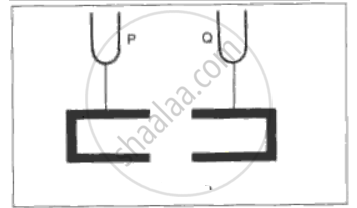
In fig. shows two tuning forks P and Q of the same frequency mounted on separate sound boxes with their open ends facing each other. The fork A is set into vibration. (i) Describe your observation. (ii) State the principle illustrated by this experiment.
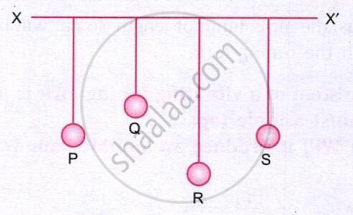
In Fig. 17, \(P, Q, R\) and \(S\) are four pendulums suspended from the same elastic string \(X X^{\prime}\). Lengths of pendulum \(P\) and \(S\) are equal, while the length of \(Q\) is smaller and \(R\) is longer. The pendulum \(P\) is set into vibration. What is your observation? Give reasons for your observation.
Match items of column I with the corresponding items of column II.
| Column I | Column II |
|---|---|
| 1. Intensity of sound wave | (a) Hz |
| 2. Energy associated with an ultrasound wave | (b) \[\mathrm{m}{s}^{-1}\] |
| 3. SI unit of frequency | (c) decibel |
| 4. Velocity of shock wave | (d) 20 Hz – 20,000 Hz |
| 5. Loudness of sound wave | (e) joule |
| 6. Range of hearing in humans | (f) \[\mathrm{W}{m}^{-2}\] |
Frank solutions for फिज़िक्स पार्ट [अंग्रेजी] कक्षा १० आईसीएसई 3 Sound Frequently Asked Questions in Board Examination [Pages 207 - 209]
- Name the waves used for echo depth sounding.
- Give one reason for their use for the above purpose.
- Why are the waves mentioned by you not audible to us?
What is an echo?
State two conditions for an echo to take place.
- Name a phenomenon involved in tuning a radio set to a particular station.
- Define the phenomenon named by you in part (i) above.
- What do you understand by loudness of sound
- In which units loudness of sound is measured?
A type of electromagnetic wave has wavelength 50 Å.
- Name the wave.
- What is the speed of this wave in vacuum?
- State one use of this type of wave.
State one important property of waves used for echo depth sounding.
A radar sends a signal to an aircraft at a distance of 30 km away and receives it back after 2 x 10⁻⁴ seconds. What is the speed of the signal?
Which characteristics of sound will change if there is a change in its amplitude.
Which characteristics of sound will change if there is a change in its waveform.
Name one factor which affects the frequency of sound emitted due to vibrations in an air column.
Draw a graph between displacement and the time for a body executing free/natural vibrations.
Where can a body execute free vibrations?
State the safe limit of sound level in terms of decibel for human hearing.
Name the characteristic of sound in relation to its waveform.
A person standing between two vertical cliffs and 480 m from the nearest cliff shouts. He hears the first echo after 3s and the second echo 2s later. Calculate:
- The speed of sound.
- The distance of the other cliff from the person
A vibrating tuning fork is placed over the mouth of a burette filled with water. The tap of the burette is opened and the water level gradually starts falling. It is found that the sound from the tuning fork becomes very loud for a particular length of the water column.
- Name the phenomenon taking place when this happens.
- Why does the sound become very loud for this length of the water column?
What is meant by the term amplitude of a wave?
What is meant by the term frequency, of a wave?
Explain why stringed musical instruments, like the guitar, are provided with a hollow box.
What are mechanical waves?
Name one property of waves that do not change when the wave passes from one medium to another.
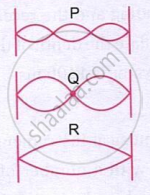
The diagram above shows three different modes of vibration P, Q and R of the same string:
- Which vibration will produce a louder sound and why?
- The sound of which vibration will have maximum shrillness?
- State the ratio of wavelengths P and R.
The ratio of the amplitudes of two waves is 3 : 4. What is the ratio of their loudness?
The ratio of the amplitude of two waves is 3 : 4. What is the ratio of their Frequencies?
State the ways by which the frequency of transverse vibrations of a stretch string can be increased.
What is meant by noise pollution?
Name one source of sound causing noise pollution.
(i) A man stands at a distance of 68 m from a cliff and fires a gun. After what time interval will he hear the echo, if the speed of sound in air is 340 ms−1?
(ii) If the man had been standing at a distance of 12 m from the cliff would he have heard a clear echo?
When acoustic resonance takes place, a loud sound is heard. Why does this happen? Explain.
Three musical instruments give out notes at the frequencies listed below. Flute: 400 Hz; Guitar: 200 Hz; Trumpet: 500 Hz. Which one of these has the highest pitch?
An ultrasonic wave is sent from a ship towards the bottom of the sea. It is found that the time interval between the sending and the receiving of the wave is 1.5 second. Calculate the depth of the sea if the velocity of sound in sea water is 1400 ms−1.
A stringed musical instrument, such as the sitar, is provided with a number of wires of different thickness. Explain the reason for this.
What is the principle on which sonar is based?
Calculate the minimum distance at which a person should stand in front of a reflecting surface so that he can hear a distinct echo.
(Take speed of sound in air = 350 ms−1.)
- Name the characteristic of sound which enables a person to differentiate between two sounds with equal loudness but having different frequencies.
- Define the characteristic named by you in (i).
A tuning fork, struck by a rubber pad, is held over a length of air column in a tube. It produces a loud sound for a fixed length of air column.
- Name the above phenomenon.
- How does the frequency of loud sound compare with that of the tuning fork?
- State the unit for measuring loudness.
A man standing in front of a vertical cliff fires a gun. He hears the echo after 3 seconds. On moving closer to the cliff by 82.5 m, he fires again. This time, he hears the echo after 2.5 seconds. Calculate:
- the distance of the cliff from the initial position of the man.
- the velocity of sound.
A radar sends a signal to an aeroplane at a distance of 45 km away with a speed of 3 × 10⁸ m s−1. After how long is the signal received back from the aeroplane?
What is meant by an echo?
Mention one important condition is necessary for an echo to be heard distinctly.
Mention one important use of echo.
Sometimes when a vehicle is driven at a particular speed, a rattling sound is heard. Explain briefly, why this happens and give the name of the phenomenon taking place.
Suggest one way by which the rattling sound can be stopped.
A man playing a flute is able to produce notes of different frequencies. If he closes the holes near his mouth, will the pitch of the note produced, increase or decrease? Give a reason.
Define resonant vibrations.
Which characteristic of sound makes it possible to recognize a person by his voice without seeing him?
Two waves of the same pitch have amplitudes in the ratio 1 : 3. What will be the ratio of their:
- intensities and
- frequencies
It is observed that during march-past we hear a base drum distinctly from a distance compared to the side drums.
(i) Name the characteristics of sound associated with the above obervation.
(ii) Give a reason for the above observation.
A pendulum has a frequency of vibrations per second. An observer starts the pendulum and fires a gun simultaneously. He hears the echo from the cliff after 6 vibrations or the pendulum. If the velocity of sound in air is 340 m/s, find the distance between the cliff and the observer.
Two pendulums C and D are suspended from a wire as shown in the figure give below. Pendulum C is made to oscullate by displaying it from its mean position. It is seen that D also starts oscillating.
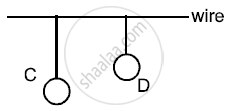
(i) Name the type of oscillation, C will execute.
(ii) Name the type of oscillation, D will execute.
(iii) If the length of D is made equal to C then what difference will you notice in the oscillations of D ?
(iv) What is the name of the phenomenon when the length of D is made equal to C ?
Name the system which enables us to locate underwater objects by transmitting ultrasonic waves and detecting the reflecting impulse.
What are acoustically measurable quantities related to pitch and loudness?
When a tuning fork (vibrating) is held close to ear, one hears a faint hum. The same [vibrating tuning fork] is held such that its stem is in contact with the table surface, then one hears a loud sound. Explain.
A man standing in front of a vertical cliff fires a gun. He hears the echo after 3.5 s. On moving closer to the cliff by 84 m, he hears the echo after 3 s. Calculate the distance of the cliff from the initial position of the man.
A metal foot ruler is held at the edge of a table. It is pressed at its free end and then released. It vibrates.
- Name the vibrations produced.
- State one way to increase the frequency of these vibrations.
Which characteristic of sound is affected due to the larger surface of a school bell?
Calculate the distance covered by the Ultrasonic wave having a velocity of 1.5 kms-1 in 14 s, when it is received after reflection by the receiver of the SONAR.
Rohan conducted experiments on echo in different media. He observed that a minimum distance of 'x' meters is required for the echo to be heard in oxygen and 'y' meters in benzene. Compare 'x' and 'y'. Justify your answer.
Speed of sound in oxygen: 340 ms-1
Speed of sound in benzene: 200 ms-1
Name the waves used in SONAR.

In the above diagram Lata stands between two cliffs and claps her hands.
Determine the time taken by her to hear the first echo. Speed of sound in air 320 ms-1.
|
In the given diagram, a vibrating tuning fork is kept near the mouth of a burette filled with water. The length of the air column is adjusted by opening the tap of the burette. At a length of 5 cm of the air column, a loud sound is heard
|

- Name the phenomenon illustrated by the above experiment.
- Why is a loud sound heard at this particular length?
- If the present tuning fork is replaced with a tuning fork of higher frequency, should the length of the air column increase or decrease to produce a loud sound? Give a reason.
Frank solutions for फिज़िक्स पार्ट [अंग्रेजी] कक्षा १० आईसीएसई 3 Sound Exercises (Cumulative Revision) [Pages 211 - 212]
What is meant by an echo?
Explain how the principle of echo is used by
The bat during its flight at night
Explain how the principle of echo is used by the dolphin to locate small fish as its prey.
Explain the following and illustrate your answer by drawing appropriate diagram:
Frequency
Explain the following and illustrate your answer by drawing appropriate diagram:
Loudness
Explain the following and illustrate your answer by drawing appropriate diagram:
Pitch
Explain the following and illustrate your answer by drawing appropriate diagram:
Quality of a musical note.
Define the term velocity as applied to a sound wave.
Define the relation between velocity, wavelength, and frequency of the wave.
State the characteristic of a musical note on which its loudness depends.
State the characteristic of a musical note on which its quality depends.
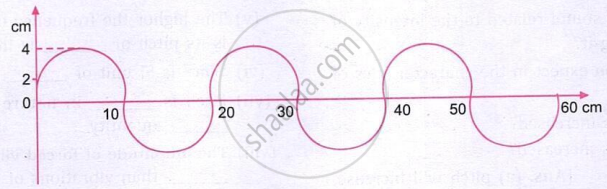
In fig. shows a snapshot of a wave from of frequency 50 Hz in a string. The numbers in the diagram represents distance in centimeters. For this wave motion, find
- wavelength
- amplitude
- velocity
Differentiate between the following:
Light and sound waves.
Differentiate between the following:
Free and forced vibrations.
Differentiate between the following:
Radio waves and light waves.
What is meant by resonance?
Name musical instrument, one in each case, which produces its notes by using the following. In each case state the method used to produce notes of different pitches and loudness.
(a) A vibrating string.
(b) A vibrating column air.
(c) Vibration of any other body.
Give scientific reasons for the following:
When a nail is hammered into a piece of wood, the noise of the hammering appears to get higher and higher in pitch.
Give scientific reason for the following:
Windows sometimes rattle when the low notes of a pipe organ are sounded.
What is the safe limit of sound level in dB for our ears?
What determines the pitch of a sound?
How is it possible to recognize a person by his voice without seeing him?
How does the waveform of a loud note differ from a soft note?
Why is the loudness of sound heard by a plucked wire increased when mounted on a sound board?
State the unit in which the intensity of a sound wave is measured.
How is the loudness of sound related to the intensity of the wave producing it?
What change do you expect in the characteristic of a musical sound if its frequency is increased?
What change do you expect in the characteristic of a musical sound if its amplitude is increased?
Comment on the statement 'loudness of sound is a subjective quantity, while intensity is an objective quantity.
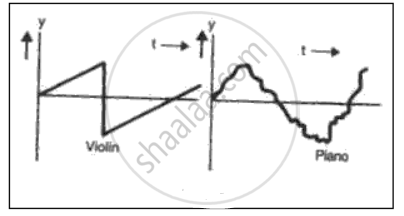
In fig. 2 two musical notes of the same pitch and same loudness are played on a violin and on a piano. Their wave forms are as shown in the diagram below. Explain why the wave patterns are different.
Select the most appropriate word from the given box and fill in the blank:
| loudness intensity decibel objective subjective shriller pitch intensity amplitude less force |
Noise pollution at a particular place is determined by the ______ of the sound.
Select the most appropriate word from the given box and fill in the blank:
| loudness intensity decibel objective subjective shriller pitch intensity amplitude less force |
Intensity of sound varies directly as the square of the ______ of the vibrations.
Select the most appropriate word from the given box and fill in the blank:
| loudness intensity decibel objective subjective shriller pitch intensity amplitude less force |
The sharpness of a musical note depends on its ______.
Select the most appropriate word from the given box and fill in the blank:
| loudness intensity decibel objective subjective shriller pitch intensity amplitude less force |
The loudness of sound is measured in ______.
Select the most appropriate word from the given box and fill in the blank:
| loudness intensity decibel objective subjective shriller pitch intensity amplitude less force |
The higher the frequency of a note, the higher is its pitch or ______ is the note.
Select the most appropriate word from the given box and fill in the blank:
| loudness intensity decibel objective subjective shriller pitch intensity amplitude less force |
Wm−2 is SI unit of ______ of sound wave.
Select the most appropriate word from the given box and fill in the blank:
| loudness intensity decibel objective subjective shriller pitch intensity amplitude less force |
Pitch is ______ in nature while frequency is ______ quantity.
Select the most appropriate word from the given box and fill in the blank:
| loudness intensity decibel objective subjective shriller pitch intensity amplitude less force |
The amplitude of forced vibrations is generally ______ than vibrations of external ______.
Frank solutions for फिज़िक्स पार्ट [अंग्रेजी] कक्षा १० आईसीएसई 3 Sound Multiple Choice Questions and Assertion-Reason Type Questions [Pages 213 - 216]
Wave transmits ____ from one place to another.
mass
amplitude
wavelength
energy
Sound waves do not travel through ______.
solids
liquids
gases
vacuum
The physical quantity which oscillates in most waves is ______.
mass
energy
amplitude
wavelength
Waves of short duration are known as ______.
sound waves
light waves
pulses
none of these
In a transverse wave, the individual particles of the medium move ______.
in circles
in an ellipse
parallel to the direction of wave travel
perpendicular to the direction of wave travel
Sound waves are ______.
longitudinal
transverse
partly longitudinal and partly transverse
sometimes longitudinal and sometimes transverse
The frequency which is not audible to the human ear is ______.
50 Hz
500 Hz
5000 Hz
50,000 Hz
The speed of sound in a medium depends upon ______.
amplitude
frequency
wavelength
properties of the medium
Which of the following will remain unchanged when a sound wave travels in air or in water?
Amplitude
Wavelength
Frequency
Speed
A sound source sends waves of 400 Hz. It produces waves of wavelength 2.5 m. The velocity of sound waves is ______.
$$100 \mathrm{~ms}^{-1}$$
$$1000 \mathrm{~ms}^{-1}$$
$$10,000 \mathrm{~ms}^{-1}$$
none of these
The time period of a vibrating body is 0.05 s. The frequency of waves it emits is ______.
5 Hz
20 Hz
200 Hz
2 Hz
A boat at anchor is rocked by waves whose crests are 100 m a part and whose velocity is $$25 \mathrm{~ms}^{-1}$$. These waves reach the boat every ______.
2,500 s
75 s
4 s
0.25 s
Sound waves cannot travel through ______.
air
water
vacuum
all of these.
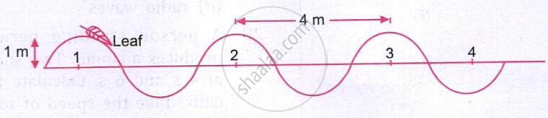
If the wave is moving to the right after 4 seconds the leaf will be at the position:

1
2
3
4
The amplitude of the wave is:
0.5 m
1 m
2 m
1.5 m
The horizontal speed of the wave is:

$$ 1 \mathrm{~ms}^{-1}$$
$$ 2 \mathrm{~ms}^{-1}$$
$$ 4 \mathrm{~ms}^{-1}$$
$$ 0.5 \mathrm{~ms}^{-1}$$
A source of frequency of 500 Hz emits waves of wavelength 0.4 m. How long does it take the waves to travel 600 m?
3 s
6 s
9 s
12 s
Sound and light waves both ______.
have similar wavelength
obey the laws of reflection
travel as longitudinal waves
travel through vacuum
The time taken by a crest to travel a distance $$\lambda$$ is ______.
T
$$\dfrac{T}{2}$$
$$\dfrac{T}{4}$$
$$\dfrac{T}{8}$$
The distance between a crest and the next trough in a transverse wave is ______.
$$\dfrac{\lambda}{2}$$
$$\dfrac{\lambda}{4}$$
$$\lambda$$
$$2\lambda$$
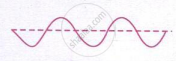
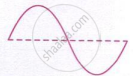
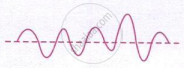
The sketches I to IV in Fig. show sound waves, all formed in the same time interval. Which diagram shows a note from a musical instrument?
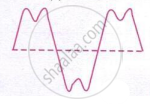
I
II
III
IV
Which pattern in Fig. shows a soft (not loud) note?
I
II
III
IV
Which pattern in Fig. shows a bass (low frequency) note?
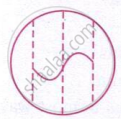
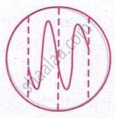
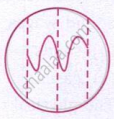
I
II
III
none of these.
A microphone is connected to the Y-input of a C.R.O. Three different sounds are made in turn in front of the microphone. Their traces produced on the screen are as shown in Fig. Which pattern in Fig. is due to the loudest sound?
I
II
III
nothing can be decided
Which pattern in Fig. is due to the sound with the lowest pitch?
I
II
III
Nothing can be decided
To hear the echo of a sound distinctly, the reflecting surface in air should be at a minimum distance of $$p$$ from the listener. Then $$p$$ should be ______.
7 m
10 m
15 m
17 m
Bats detect the obstacles in their path by receiving the reflected ______.
infrasonic waves
ultrasonic waves
electromagnetic waves
radio waves
A person standing between two vertical cliffs produces a sound. Two successive echoes are heard at 4 s and 6 s. Calculate the distance between the cliffs. Take the speed of sound in air $$=320 \mathrm{~ms}^{-1}$$.
1000 m
1200 m
1400 m
1600 m
Figure shows three different modes of vibration of a string.
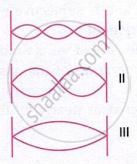
What is the ratio of frequency between (a) and (c)?
3 : 1
2 : 1
1 : 2
1 : 3
The diagram below shows three ways in which the string of an instrument can vibrate.
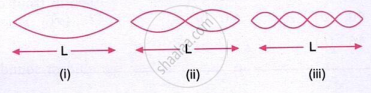
Which has the frequency four times that of the first?
I
II
III
Nothing can be decided
Assertion and Reason Type Questions Choose the correct answers to the questions from the given options.
Assertion (A): During wave motion, no matter is transferred but only energy gets transferred.
Reason (R): Wave motion can be produced only in a medium having elasticity and inertia.
If both Assertion and Reason are true and the Reason is correct explanation of the Assertion.
If both Assertion and Reason are true, but Reason is not correct explanation of the Assertion.
If Assertion is true, but the Reason is false.
If Assertion is false, but the Reason is true.
Assertion: Energy could be transferred through matter by mechanical waves.
Reason: Light waves, heat waves and sound waves do not require a medium for their propagation as these are not mechanical waves.
If both Assertion and Reason are true and the Reason is correct explanation of the Assertion.
If both Assertion and Reason are true, but Reason is not correct explanation of the Assertion.
If Assertion is true, but the Reason is false.
If Assertion is false, but the Reason is true.
Assertion (A): Two astronauts cannot talk to each other on the moon as they do on the earth.
Reason (R): There is no atmosphere or material medium on the moon.
If both Assertion and Reason are true and the Reason is correct explanation of the Assertion.
If both Assertion and Reason are true, but Reason is not correct explanation of the Assertion.
If Assertion is true, but the Reason is false.
If Assertion is false, but the Reason is true.
Assertion (A): One cannot hear a bomb explosion on the moon.
Reason (R): There is no atmosphere on the moon, hence the sound produced due to explosion cannot be transferred.
If both Assertion and Reason are true and the Reason is correct explanation of the Assertion.
If both Assertion and Reason are true, but Reason is not correct explanation of the Assertion.
If Assertion is true, but the Reason is false.
If Assertion is false, but the Reason is true.
Assertion (A): Longitudinal waves can travel through all media, i.e., solids, liquids and gases.
Reason (R): In case of longitudinal waves, one wavelength contains one compression or one rarefaction.
If both Assertion and Reason are true and the Reason is correct explanation of the Assertion.
If both Assertion and Reason are true, but Reason is not correct explanation of the Assertion.
If Assertion is true, but the Reason is false.
If Assertion is false, but the Reason is true.
Assertion (A): Transverse waves can travel through solids and on the surface of liquids.
Reason (R): In case of transverse waves, one wavelength contains one crest or one trough.
If both Assertion and Reason are true and the Reason is correct explanation of the Assertion.
If both Assertion and Reason are true, but Reason is not correct explanation of the Assertion.
If Assertion is true, but the Reason is false.
If Assertion is false, but the Reason is true.
Assertion (A): An echo is formed due to reflection of sound.
Reason (R): Reflection of sound takes place in the same way as reflection of light waves.
If both Assertion and Reason are true and the Reason is correct explanation of the Assertion.
If both Assertion and Reason are true, but Reason is not correct explanation of the Assertion.
If Assertion is true, but the Reason is false.
If Assertion is false, but the Reason is true.
Assertion (A): For hearing a distinct echo, the minimum distance of the obstacle from the source of sound should be 17.2 m.
Reason (R): This distance changes with change of temperature.
If both Assertion and Reason are true and the Reason is correct explanation of the Assertion.
If both Assertion and Reason are true, but Reason is not correct explanation of the Assertion.
If Assertion is true, but the Reason is false.
If Assertion is false, but the Reason is true.
Assertion (A): The distance between 5 consecutive compressions in a sound wave is 5 cm. So, the wavelength of sound wave is 1.25 cm.
Reason (R): The length between 2 consecutive compressions equals the wavelength, hence 1 wavelength equals $$\frac{5}{4} \text{ cm}$$.
If both Assertion and Reason are true and the Reason is correct explanation of the Assertion.
If both Assertion and Reason are true, but Reason is not correct explanation of the Assertion.
If Assertion is true, but the Reason is false.
If Assertion is false, but the Reason is true.
Assertion (A): Eleven consecutive rarefactions of a wave pass a given point in 10 seconds. The time period of the wave is 1 second.
Reason (R): There will be 10 wavelengths between 11 rarefactions. So, time for 1 wavelength (which equals time period of the wave) equals 1 second.
If both Assertion and Reason are true and the Reason is correct explanation of the Assertion.
If both Assertion and Reason are true, but Reason is not correct explanation of the Assertion.
If Assertion is true, but the Reason is false.
If Assertion is false, but the Reason is true.
Assertion (A): The product of time period and frequency of a wave is unity.
Reason (R): Time period = $$\frac{1}{\text{Frequency}}$$
If both Assertion and Reason are true and the Reason is correct explanation of the Assertion.
If both Assertion and Reason are true, but Reason is not correct explanation of the Assertion.
If Assertion is true, but the Reason is false.
If Assertion is false, but the Reason is true.
Assertion (A): The sound produced by the humming bees can be easily heard by us.
Reason (R): The frequency of sound produced by humming bees is about 440 Hz, and it lies in the audible range, i.e, 20 Hz - 20,000 Hz.
If both Assertion and Reason are true and the Reason is correct explanation of the Assertion.
If both Assertion and Reason are true, but Reason is not correct explanation of the Assertion.
If Assertion is true, but the Reason is false.
If Assertion is false, but the Reason is true.
Assertion (A): The sound of vibrations produced by a vibrating pendulum cannot be heard by us.
Reason (R): The frequency of a vibrating pendulum is very small and does not lie in the audible range.
If both Assertion and Reason are true and the Reason is correct explanation of the Assertion.
If both Assertion and Reason are true, but Reason is not correct explanation of the Assertion.
If Assertion is true, but the Reason is false.
If Assertion is false, but the Reason is true.
Assertion (A): Greater the mass of air which can be set into vibration, the louder will be sound.
Reason (R): The intensity of sound is related to its frequency.
If both Assertion and Reason are true and the Reason is correct explanation of the Assertion.
If both Assertion and Reason are true, but Reason is not correct explanation of the Assertion.
If Assertion is true, but the Reason is false.
If Assertion is false, but the Reason is true.
Assertion (A): Pitch is the shrillness of a note. The high or low sound is determined by its amplitude.
Reason (R): Pitch is one’s judgement of how high or low a sound is, and is subjective entity incapable of physical measurement.
If both Assertion and Reason are true and the Reason is correct explanation of the Assertion.
If both Assertion and Reason are true, but Reason is not correct explanation of the Assertion.
If Assertion is true, but the Reason is false.
If Assertion is false, but the Reason is true.
Assertion (A): The speed of sound increases with increase in temperature of the gas.
Reason (R): For 1°C rise in temperature, the speed of sound in air increases nearly by 0.51 ms−1.
If both Assertion and Reason are true and the Reason is correct explanation of the Assertion.
If both Assertion and Reason are true, but Reason is not correct explanation of the Assertion.
If Assertion is true, but the Reason is false.
If Assertion is false, but the Reason is true.
Solutions for 3: Sound
Frank solutions for फिज़िक्स पार्ट [अंग्रेजी] कक्षा १० आईसीएसई chapter 3 - Sound
Shaalaa.com has the CISCE Mathematics फिज़िक्स पार्ट [अंग्रेजी] कक्षा १० आईसीएसई CISCE solutions in a manner that help students grasp basic concepts better and faster. The detailed, step-by-step solutions will help you understand the concepts better and clarify any confusion. Frank solutions for Mathematics फिज़िक्स पार्ट [अंग्रेजी] कक्षा १० आईसीएसई CISCE 3 (Sound) include all questions with answers and detailed explanations. This will clear students' doubts about questions and improve their application skills while preparing for board exams.
Further, we at Shaalaa.com provide such solutions so students can prepare for written exams. Frank textbook solutions can be a core help for self-study and provide excellent self-help guidance for students.
Concepts covered in फिज़िक्स पार्ट [अंग्रेजी] कक्षा १० आईसीएसई chapter 3 Sound are Sound Waves, Forced Vibrations, Resonance (a special case of forced vibrations), Demonstration of Resonance, Examples of Resonance, Characteristics of Sound, Reflection of Sound Waves, Echo, Determination of Speed of Sound by the Method of Echo, Use of Echoes, Natural Vibrations, Damped Vibrations, Loudness and Intensity, Pitch and frequency, Quality and Wave Form, Music and Noise, Light Waves vs Sound Waves, Natural Vibrations vs Damped Vibrations, Natural Vibrations vs Forced Vibrations, Forced Vibrations vs Resonant Vibrations, Sound Waves, Forced Vibrations, Resonance (a special case of forced vibrations), Demonstration of Resonance, Examples of Resonance, Characteristics of Sound, Reflection of Sound Waves, Echo, Determination of Speed of Sound by the Method of Echo, Use of Echoes, Natural Vibrations, Damped Vibrations, Loudness and Intensity, Pitch and frequency, Quality and Wave Form, Music and Noise, Light Waves vs Sound Waves, Natural Vibrations vs Damped Vibrations, Natural Vibrations vs Forced Vibrations, Forced Vibrations vs Resonant Vibrations.
Using Frank फिज़िक्स पार्ट [अंग्रेजी] कक्षा १० आईसीएसई solutions Sound exercise by students is an easy way to prepare for the exams, as they involve solutions arranged chapter-wise and also page-wise. The questions involved in Frank Solutions are essential questions that can be asked in the final exam. Maximum CISCE फिज़िक्स पार्ट [अंग्रेजी] कक्षा १० आईसीएसई students prefer Frank Textbook Solutions to score more in exams.
Get the free view of Chapter 3, Sound फिज़िक्स पार्ट [अंग्रेजी] कक्षा १० आईसीएसई additional questions for Mathematics फिज़िक्स पार्ट [अंग्रेजी] कक्षा १० आईसीएसई CISCE, and you can use Shaalaa.com to keep it handy for your exam preparation.
