Advertisements
Advertisements
प्रश्न
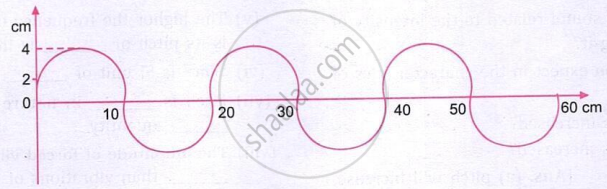
In fig. shows a snapshot of a wave from of frequency 50 Hz in a string. The numbers in the diagram represents distance in centimeters. For this wave motion, find
- wavelength
- amplitude
- velocity
Advertisements
उत्तर
Given: \[ f=50\ \text{Hz} \]
(a) Distance between two successive crests:
\[\lambda=20\ \text{cm}=0.20\ \text{m}\]
\[{\lambda=20\ \text{cm}}\]
(b) Amplitude = Maximum displacement of the particles from the mean position = 4 cm
(c) Velocity = frequency × wave length
\[ v=f\lambda \]
\[ v=50\times0.20 \]
\[ {v=10\ \text{m s}^{-1}} \]
APPEARS IN
संबंधित प्रश्न
Which one of the following does not consist of transverse waves?
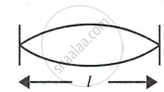
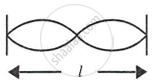
Fig. shows three ways in which a string of length l in an instrument can vibrate.
 |
 |
 |
| (i) | (ii) | (iii) |
- Which of the diagram shows the principle note?
- Which vibration has the frequency four times that of the first?
- Which vibration is of the longest wavelength?
- What is the ratio of the frequency of the vibration in (i) and (ii)?
The speed of sound is more in hydrogen than in nitrogen. Is this statement true? Give a reason for your answer.
Give a scientific reason.
If you were both on the moon, your friend will not be able to hear you call.
Select the correct option:
The longitudinal waves can propagate only in
What is sound? Explain with example how does sound travel in a medium.
Explain how the principle of echo is used by
The bat during its flight at night
Sound waves travel very fast in
