Advertisements
Advertisements
प्रश्न
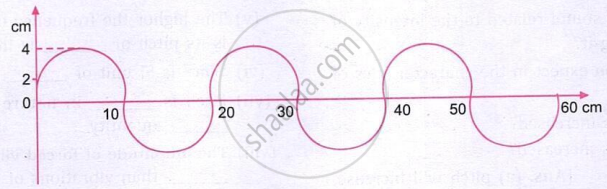
In fig. shows a snapshot of a wave from of frequency 50 Hz in a string. The numbers in the diagram represents distance in centimeters. For this wave motion, find
- wavelength
- amplitude
- velocity
Advertisements
उत्तर
Given: \[ f=50\ \text{Hz} \]
(a) Distance between two successive crests:
\[\lambda=20\ \text{cm}=0.20\ \text{m}\]
\[{\lambda=20\ \text{cm}}\]
(b) Amplitude = Maximum displacement of the particles from the mean position = 4 cm
(c) Velocity = frequency × wave length
\[ v=f\lambda \]
\[ v=50\times0.20 \]
\[ {v=10\ \text{m s}^{-1}} \]
APPEARS IN
संबंधित प्रश्न
What type of waves are illustrated by the movement of a rope whose one end is fixed to a pole and the other end is moved up and down?
What is the nature of sound waves in air?
The longitudinal waves travel in a coiled spring at a rate of 4 m/s. The distance between two consecutive compressions is 20 cm. Find :
(i) Wavelength of the wave (ii) Frequency of the wave
A continuous progressive transverse wave of frequency 8 Hz moves across the surface of a ripple tank
If the wavelength of the transverse wave is 32 mm, calculate the speed with which wave travels across the surface of the water.
Sound travels in air:
Suppose that a sound wave and a light wave have the same frequency, then which one has a longer wavelength?
Why is the ceiling and wall behind the stage of good conference halls or concert halls made curved?
Sound travels in the air as ______ wave.
______ is an unwanted sound.
Find the odd one out.
