Advertisements
Advertisements
Question
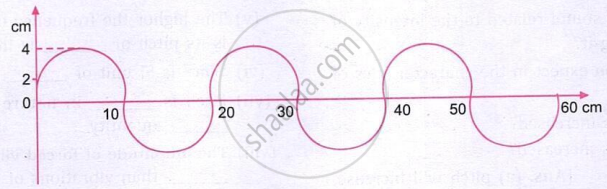
In fig. shows a snapshot of a wave from of frequency 50 Hz in a string. The numbers in the diagram represents distance in centimeters. For this wave motion, find
- wavelength
- amplitude
- velocity
Advertisements
Solution
Given: \[ f=50\ \text{Hz} \]
(a) Distance between two successive crests:
\[\lambda=20\ \text{cm}=0.20\ \text{m}\]
\[{\lambda=20\ \text{cm}}\]
(b) Amplitude = Maximum displacement of the particles from the mean position = 4 cm
(c) Velocity = frequency × wave length
\[ v=f\lambda \]
\[ v=50\times0.20 \]
\[ {v=10\ \text{m s}^{-1}} \]
APPEARS IN
RELATED QUESTIONS
What is sound ?
What type of wave is represented :
(a) by density-distance graph?
(b) by displacement-distance graph?
What is the difference between a compression and a rarefaction in a sound wave? Illustrate your answer with a sketch.
The flash of a gun is seen by a man 3 seconds before the sound is heard. Calculate the distance of the gun from the man (Speed of sound in air is 332 m/s).
Before playing the orchestra in a musical concert, a sitarist tries to adjust the tension and pluck the strings suitably. By doing so he is adjusting :
'Note' is a sound :
The sound of which of the following frequency is audible to us?
2 Hz, 1000 Hz, 200 kHz, 8 MHz
What are the uses of infrasonic sound?
