Advertisements
Advertisements
Question
What is the difference between a compression and a rarefaction in a sound wave? Illustrate your answer with a sketch.
Advertisements
Solution
A longitudinal wave consists of successive compression and rarefaction that is formed due to continuous to and fro motion of a vibrating object.
A compression is that part of a longitudinal wave in which the particles of the medium are closer to one another than they normally are, and there is a momentary reduction in volume of the medium. It is a region of high pressure and high density.
A rarefaction is that part of a longitudinal wave in which the particles of the medium are farther apart than normal, and there is a momentary increase in the volume of the medium. It is a region of low pressure and low density.
APPEARS IN
RELATED QUESTIONS
Write true or false for a given statement.
Larger is the amplitude, feeble is the sound.
Define time period.
What are infrasonics? Can you hear them?
Name the type of waves produced when a tuning fork is struck in air.
How are the wave velocity V, frequency f and wavelength λ of a wave related? Derive the relationship.
Describe briefly an experiment to prove that vibrating bodies produce sound.
Draw a displacement-time graph for water wave.
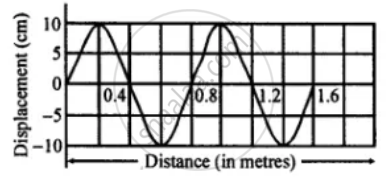
The diagram given below shows a displacement distance graph of a wave. If the velocity of wave is 160 ms-1, calculate:
- wavelength
- frequency
- amplitude.
State the effect of pressure on the speed of sound in air.
What is echolocation? How do animals make use of this phenomenon?
