Advertisements
Chapters
![Lakhmir Singh solutions for Physics (Science) [English] Class 9 ICSE chapter 5 - Sound - Shaalaa.com](/images/physics-science-english-class-9-icse_6:911f810b387d4e338a7779e8e703c1e7.jpg "Lakhmir Singh solutions for Physics (Science) [English] Class 9 ICSE chapter 5 - Sound")
Advertisements
Solutions for Chapter 5: Sound
Below listed, you can find solutions for Chapter 5 of CBSE Lakhmir Singh for Physics (Science) [English] Class 9 ICSE.
Lakhmir Singh solutions for Physics (Science) [English] Class 9 ICSE 5 Sound Very Short Answers 1 [Pages 185 - 188]
Can sound travel through (a) iron, and (b) water?
Can sound travel through vacuum?
Name the type of waves which are used by astronauts to communicate with one another on moon (or in outer space).
Name one solid, on liquid and one gas through which sound can travel.
Which of the following cannot transmit sound? Water, Vacuum, Aluminium, Oxygen gas
Name the physical qantity whose SI unit is 'hertz'.
What is the SI unit of frequency?
What type of wave is represented :
(a) by density-distance graph?
(b) by displacement-distance graph?
Is the speed of sound more in water or in steel?
In which medium sound travels faster : air or iron?
In which medium sound travels fastest : air, water or steel?
Out of solids, liquids and gases :
(a) in which medium sound travels slowest?
(b) in which medium sound travels fastest?
Which of the following is the speed of sound in copper and which in aluminium?
(a) 5100 m/s
(b) 1500 m/s
(c) 3750 m/s
If you want to hear a train approaching from far away, why is it more convenient to put the ear to the track?
What is the speed of sound :
(a) in air?
(b) in water?
(c) in iron?
What name is given to those aircrafts which fly at speeds greater than the speed of sound?
A jet aircraft flies at a speed of 410 m/s. What is this speed known as?
What is meant by supersonic speed?
State one observation from everyday life which shows that sound travels much more slow than light.
Name the two types of waves which can be generates in a long flexible spring (or slinky).
A stone is dropped on the surface of water in a pond. Name the type of waves produced.
Name the type of waves produced when a tuning fork is struck in air.
What is the general name of the waves consisting of :
(a) compressions and rarefactions?
(b) crests and troughs?
State the general name of the waves in which the particles of the medium vibrate :
(i) in the same direction as wave.
(ii) at right angles to the direction of wave.
What type of waves are illustrated by the movement of a rope whose one end is fixed to a pole and the other end is moved up and down?
What should an object do to produce sound?
What is the name of the strings which vibrate in our voice box when we talk?
Name the device which is used to produce sound in laboratory experiments?
What is the nature of sound waves in air?
What conclusion can be obtained from the observation that when the prongs of a sound making tuning fork touch the surface of water in a beaker, the water gets splashed?
State whether the following statement is true or false :
Sound produced by a vibrating body travels to our ears by the actual movement of air.
Which of the following travels slowest in air and which one fastest? Supersonic aircraft, Light, Sound
Which term is used to denote a speed greater than the speed of sound?
In which medium sound travels faster : air or hydrogen?
A tuning fork has a number 256 marked on it. What does this number signify?
What is the time-period of a tuning fork whose frequency is 200 Hz?
Calculate the frequency of a wave whose time-period is 0.02 s.
What will be the change in the wavelength of a sound wave in air if its frequency is doubled?
If 20 waves are produced per second, What is the frequency is hertz?
Fill in the blank with suitable word .
Sound waves are caused by ...................
Fill in the blanks with suitable words.
A sound wave consists of places of higher pressure called ................. and places of................pressure called.................
Fill in the blanks with suitable words .
Wave speed in metres per second equals frequency in ............ multiplied by ..................... in ..................
Fill in the blank with suitable word.
Sound cannot travel through ____________.
Fill in the blank with suitable word :
The speed of sound in a solid is ............... than the speed of sound in air.
Fill in the blank with suitable word.
When the frequency of the sound is increased, the wavelength ____________.
What is the vacuum? Explain why, sound cannot travel through vacuum?
Explain the term 'amplitude' of a wave. Draw the diagram of a wave and mark its amplitude on it.
Distinguish between longitudinal and transverse waves.
Are sound waves longitudinal or transverse?
A cricket ball is seen to hit the bat first and the sound of hitting is heard a little later. Why?
Explain why, the flash of lightning reaches us first and the sound of thunder is heard a little later.
Explain why, the flash of a gun shot reaches us before the sound of the gun shot.
Which of the following terms apply to sound waves in air and which to water waves?
Transverse, Rarefaction, Trough, Crest, Compression, Longitudinal
Name four ways in which sound can be produced.
Calculate the speed of a sound wave whose frequency is 2 kHz and wavelength 65 cm.
If a ringing bicycle bell is held tightly by hand, it stops producing sound. Why?
Which object is vibrating when the following sounds are produced?
(i) The sound of a sitar
(ii) The sound of a tabla
(iii) The sound of a tuning fork
(iv) The buzzing of a bee or mosquito
(v) The sound of a flute
Give reason for the following :
In most of the cases, we cannot see the vibrations of a sound producing object with our eyes.
Describe a simple experiment to show that the prongs of a sound producing tuning fork are vibrating.
When we open a gas tap of a few seconds, the sound of escaping gas is heard first but the smell of gas comes later. Why?
A sound signal of 128 vibrations per second has a wavelength of 2.7 m. Calculate the speed with which the wave travels.
A wave is moving in air with a velocity of 340 m/s. Calculate the wavelength if its frequency is 512 vibrations/sec.
Define the 'frequency' and 'time-period' of a wave. What is the relation between the two?
Explain why, a ringing bell suspended in a vacuum chamber cannot be heard outside.
The frequency of the sound emitted by the loudspeaker is 1020 Hz. Calculate the wavelength of the sound wave in air in cm where its velocity is 340 m/s.
What is the difference between a compression and a rarefaction in a sound wave? Illustrate your answer with a sketch.
What is sound? What type of waves are sound wave in air?
Describe an experiment to show that sound cannot pass through vacuum.
How is sound produced? Explain with the help of an example.
How does sound from a sound producing body travel through air to reach our ears? Illustrate your answer with the help of a labelled diagram.
An electric bell is suspended by thin wires in a glass vessel and set ringing. Describe and explain what happens if the air is gradually pumped out of the glass vessel.
Why cannot a sound be heard on the moon? How do astronauts talk to one another on the surface of moon?
Define the terms 'frequency', 'wavelength' and 'velocity' of a sound wave. What is the relation between them?
A body vibrating with a time-period of `1/256` s produces a sound wave which travels in air with a velocity of 350 m/s. Calculate the wavelength.
What are longitudinal waves and transverse waves? Explain with the help of labelled diagrams.
Give two examples each of longitudinal waves and transverse waves.
Explain the terms 'compressions' and 'rarefactions' of a wave. What type of waves consist of compressions and rarefactions.
A worker lives at a distance of 1.32 km from the factory. If the speed of sound in air be 330 m/s, how much time will the sound of factory siren take to reach the worker?
Explain the terms 'crests' and troughs' of a wave? What type of waves consist of crests and troughs?
The flash of a gun is seen by a man 3 seconds before the sound is heard. Calculate the distance of the gun from the man (Speed of sound in air is 332 m/s).
When we put our ear to a railway line, we can hear the sound of an approaching train even when the train is far off but its sound cannot be heard through the air. Why?
How could you convince a small child that when you speak, it is not necessary for air to travel from you mouth to the ear of listener?
Which of the following statement best describes frequency?
the maximum disturbance caused by a wave
the number of complete vibrations per second
the distance between one crest of a wave and the next one
the distance travelled by a wave per second
Which of the following vibrates when a musical note is produced by the cymbals in an orchestra?
stretched strings
stretched membranes
metal plates
air columns
If the speed of a wave is 340 m/s and its frequency is 1700 Hz, then λ for this wave in cm will be :
2
0.2
20
200
A musical instrument is producing a continuous note. This note cannot be heard by a person having a normal hearing rang. This note must then be passing through.
water
wax
vacuum
empty vessel
Sound travels in air :
if particles of medium travel from one place to another
if there is no moisture in the atmosphere
If disturbance moves
if both, particles as well s disturbance move from one place to another
Which one of the following does not consist of transverse waves?
light emitted by a CFL
TV signals from a satellite
ripples on the surface of a pond
musical notes of an orchestra
In the sound wave produced by a vibrating turning fork shown in the diagram, half the wavelength is represented by :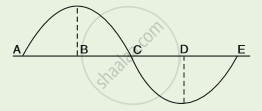
AB
BD
DE
AE
The maximum speed of vibrations which produce audible sound will be in :
dry air
sea water
ground glass
human blood
The sound waves travel fastest :
in solids
in liquids
in gases
in vacuum
The speeds of sound in four different media are given below. Which of the following is the most likely speed in m/s with which the two under water whales in a sea talk to each other when separated by a large distance?
340
5170
1280
1530
When the pitch of note produced by a harmonium is lowered, then the wavelength of the note :
decreases
first decreases and then increases
increases
remains the same
The velocities of sound waves in four media P, Q, R and S are 18,000 km/h, 900 km/h, 0 km/h and 1200 km/h respectively. Which medium could be a liquid substance?
P
Q
R
S
Which of the following can produce longitudinal waves as well as transverse waves under different conditions?
water
TV transmitter
Slinky
tuning fork
Draw the sketches of two waves A and B such that wave A has twice the wavelength and half the amplitude of wave B.
A device called oscillator is used to send waves along a stretched string. The string is 20 cm long, and four complete waves fit along its length when the oscillator vibrates 30 times per second. For the waves on the strings.
(a) what is their wavelength?
(b) what is their frequency
(c) what is their speed?
Through which of the following materials can sound travel? wood, air, water, steam, ice, hydrogen, steel, diamond.
A sound producing body is at considerable distance from a man. There can be four different media W, X, Y and Z between the sound producing body and the man. The medium X brings the sound to man most quickly whereas medium Z takes the maximum time. The time taken by medium W in bringing sound to man is less than that of X but more than that of Z. The medium Y, however, fails to bring the sound from the sound producing body to the man. Which medium could be the one :
(a) having on fixed shape and no fixed volume?
(b) having a fixed volume but no fixed shape?
(c) having the same composition as that on the moon?
(d) having a fixed shape and a fixed volume?
The longitudinal waves travel in a coiled spring at a rate of 4 m/s. The distance between two consecutive compressions is 20 cm. Find :
(i) Wavelength of the wave (ii) Frequency of the wave
Lakhmir Singh solutions for Physics (Science) [English] Class 9 ICSE 5 Sound Very Short Answers 2 [Pages 206 - 211]
Which property of sound leads of the formation of echoes ?
What name is given to the repetition of sound caused by the reflection of sound waves ?
What name is given to the persistence of sound in a big hall or auditorium ?
Name three devices which work on the reflection of sound.
What is the other name of a loud-hailer ?
Name the three characteristics of sound.
Name the unit used to measure the loudness of sound. Also write its symbol.
Name the characteristic which helps us distinguish between a man's voice and a woman's voice, even without seeing them.
How does the pitch of a sound depend on frequency ?
Name the characteristic of sound which depends on (a) amplitude (b) frequency, and (c) waveform.
Name the characteristic of sound which can distinguish between the 'notes' (musical sounds) played on a flute and a sitar (both the notes having the same pitch and loudness).
Name the organs of hearing in our body.
Name that part of ear which vibrates when outside sound falls on it.
Name the three tiny bones present in the middle part of ear.
There are three small bones in the muddle ear – anvil, hammer and stirrup :
(a) Which of these bones is in touch with ear-drum ?
(b) Which of these bones is in touch with oval window ?
What is the function of three tiny bones in the ear ?
Name the tube which connects the middle ear to throat.
Name the nerve which carries electrical impulses from the cochlea of ear to the brain.
What is the name of passage in outer ear which carries sound waves to the ear-drum ?
Why should we not put a pin or pencil in our ears ?
What type of scans are used these days to monitor the growth of developing baby in the uterus of the mother ?
How is an ultrasound scan for fetus (unborn baby) better than X-ray ?
What is the name of the device which is used to find the depth of sea (or ocean) by using ultrasonic sound waves ?
Write the full name of 'SONAR'.
Name the principle on which a soundboard works.
Name the device which is used to address a small gathering of people.
Name the device used by doctors to listen to our heartbeats.
What is the shape of a soundboard kept behind the speaker on the stage of a big hall ?
Name two sound absorbing materials (or objects) which can make our big room less echoey.
Can we hear (a) infrasonic waves (b) ultrasonic waves ?
What name is given to the sound waves of frequency too low for humans to hear ?
What name is given to the sound waves of frequency too high for humans to hear ?
What type of sound waves are produced by a vibrating simple pendulum ?
What happens to the pitch of a sound if its frequency increases ?
What happens to the loudness of a sound if its amplitude decreases ?
What name is given to sound waves of frequencies higher than 20 kHz ?
Fill in the blank with suitable word :
An echo is simply a ................... sound.
Fill in the blank with suitable word :
Pitch of sound depends on ....................
Fill in the blank with suitable word :
Loudness of sound depends on .....................
Fill in the blank with suitable word :
Quality of sound depends on ........................
Fill in the blank with suitable word :
Echoes are caused by the ...................... of sound.
On which day, a hot day or a cold day, an echo is heard sooner ? Give reason for your answer.
In which medium, air or water, an echo is heard much sooner ? Why ?
What is reverberation ? What will happen if the reverberation time in a big hall is too long ?
How can reverberations in a big hall or auditorium be reduced ?
Why do we hear more clearly in a room with curtains than in a room without curtains ?
What is a megaphone ? Name the principle on which a megaphone works.
What is a bulb horn ? Name the principle on which a bulb horn works.
What is a stethoscope ? Name the principle on which a stethoscope works.
What is a soundboard ? Explain the working of a soundboard with the help of a labelled diagram.
What is meant by the 'loudness' of sound ? On what factor does the loudness of a sound depend ?
Draw labelled diagrams to represent (a) soft sound, and (b) loud sound, of the same frequency.
Explain the term 'pitch' of a sound. On what factor does the 'pitch' of a sound depend ?
Draw labelled diagrams to represent sound of (a) low pitch, and (b) high pitch, of the same loudness.
What is meant by the quality (or timbre) of sound ? On what factor does the quality (or timbre) of a sound depend ?
Explain why, if we strike a table lightly, we hear a soft sound but if we hit the table hard, a loud sound is heard.
Give one use of ultrasound in industry and one in hospitals.
How is it that bats are able to fly at night without colliding with other objects ?
Explain how, bats use ultrasound to catch the prey.
Explain how, flaws (or defects) in a metal block can be detected by using ultrasound.
Why are the ceilings of concert halls made curved ? Draw a labelled diagram to illustrate your answer.
Draw a labelled diagram to show the multiple reflections of sound in a part of the stethoscope tube.
What is the range of frequencies associated with (a) infrasound (b) audible sound, and (c) ultrasound ?
What is the difference between infrasonic waves and ultrasonic waves ?
Choose the infrasonic waves and ultrasonic waves from the following frequencies :
(i) 10,000 Hz
(ii) 30,000 Hz
(iii) 18 Hz
(iv) 50,000 Hz
(v) 10 Hz
What is the frequency range of hearing in humans ?
Which of the following sound frequencies cannot be heard by a human ear ?
(i) 10 Hz
(ii) 100 Hz
(iii) 10,000 Hz
(iv) 15 Hz
(v) 40,000 Hz
The echo of a sound is heard after 5 seconds. If the speed of sound in air be 342 m/s, calculate the distance of the reflecting surface.
The speed of sound in water is 1500 metres per second. How far away from an under-sea rock should a deep sea diver be so that he can hear his own echo ?
What is meant by 'reflection of sound' ? What type of surfaces are the best for reflecting sound ?
Name any two objects which are good reflectors of sound.
State the laws of reflection of sound.
What is an echo ? How is echo formed ?
What is the minimum distance in air required from a sound reflecting surface to hear an echo (at 20°C) ?
A man standing 825 metres away from a cliff (steep rock) fires a gun. After how long will he hear its echo ? Speed of sound in air is 330 m/s.
What is ultrasound ? What is the difference between ordinary sound and ultrasound ?
Write any three applications (or uses) of ultrasound.
What are infrasonic waves ? Name two animals which produce infrasonic waves.
What are ultrasonic waves ? Name two animals which can produce ultrasonic waves.
The audible range of frequencies of an average human ear is from 20 Hz to 20 kHz. Calculate the corresponding wavelengths. (Speed of sound in air is 344 ms–1)
Define the following terms : (a) Echolocation (b) Echocardiography, and (c) Ultrasonography.
Name an animal which navigates and finds food by ecolocation.
Which of the two produces ultrasonic waves : porpoise or whale ?
What is sonar ? Explain its use.
A sonar station picks up a return signal after 3 seconds. How far away is the object ? (Speed of sound in water = 1440 m/s).
Draw a neat and labelled diagram of the human ear. With the help of this diagram, explain the construction and working of the human ear.
In SONAR we use:
ultrasonic waves
infrasonic waves
radio waves
audible sound waves
When we change a feeble sound to a loud sound, we increase its :
frequency
amplitude
velocity
wavelength
Which kind of sound is produced in an earthquake before the main shock wave begins ?
ultrasound
infrasound
audible sound
none of the above
Before playing the orchestra in a musical concert, a sitarist tries to adjust the tension and pluck the strings suitably. By doing so he is adjusting :
intensity of sound only
amplitude of sound only
frequency of the sitar string with the frequency of other musical instruments
loudness of sound
'Note' is a sound :
of a mixture of several frequencies
of mixture of only two frequencies
of a single frequency
always unpleasant to listen to
A key of mechanical piano is first struck gently and then struck again but much harder this time. In the second case :
sound will be louder but pitch will not be different
sound will be louder and the pitch will also be higher
sound will be louder but pitch will be lower
both loudness and pitch will remain unaffected
One of the following can hear infrasound. This one is :
dog
bat
rhinoceros
humans
An echo-sounder in a trawler (fishing boat) receives an echo from a shoal of fish 0.4 s after it was sent. If the speed of sound in water is 1500 m/s, how deep is the shoal ?
150 m
300 m
600 m
7500 m
The speed of highly penetrating ultrasonic waves is :
lower than those of audible sound waves
higher than those of audible sound waves
much higher than those of audible sound waves
same as those of audible sound waves
The ultrasound waves can penetrate into matter to a large extent because they have :
very high speed
very high frequency
very high wavelength
very high amplitude
The frequencies of four sound waves are given below. Which of these sound waves can be used to measure the depth of sea by the echo method ?
15,000 Hz
10 kHz
50 kHz
10,000 Hz
Which of the following frequency of sound can be generated by a vibrating simple pendulum as well as by the vibrating vocal cords of a rhinoceros ?
5 kHz
25 Hz
10 Hz
15,000 Hz
Which of the following device does not work on the multiple reflections of sound waves ?
stethoscope
hydrophone
soundboard
megaphone
What type of waves are generated by SONAR device fixed to a fishing ship ?
water waves
radio waves
sound waves
infrared waves
We can distinguish between the musical sounds produced by different singers on the basis of the characteristic of sound called :
frequency
timbre
pitch
loudness
At 20°C, the minimum distance of a person from a sound reflecting surface to hear an echo is :
12.2 m
17.2 m
15.2 m
34.4 m
The drawing shows a ship 800 m from a cliff. A gun is fixed on the ship. After 5 seconds the people at the front of the ship hear the sound of the gun again.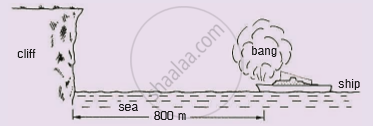
(a) What is the name of this effect ?
(b) What happens to the sound at the cliff ?
(c) How far does the sound travel in 5 seconds ?
(d) Calculate the speed of sound.
Consider the following sound waves marked A, B, C and D.
(a) Which two waves represent sounds of the same loudness but different pitch ?
(b) Which two waves represent sounds of the same frequency but different loudness ?
(c) State whether all these sound waves have been produced by the same vibrating body or different vibrating bodies ?
(d) Which vibrating body/bodies could have generated the sound waves shown here ?
In an experiment, Anhad studies sound waves. He sets up a loudspeaker to produce sound as shown below :
Anhad adjusts the signal to the loudspeaker to give a sound of frequency 200 Hz.
(a) What happens to the air in-between Anhad and the loudspeaker ?
(b) Explain how Anhad receives sound in both ears.
Figure X shows a trace of a sound wave produced by a particular tuning fork :
(a) On the graph paper given in Figure Y, draw a trace of the sound wave which has a higher frequency than that shown in figure X.
(b) On the graph paper show in Figure Z, draw a trace of the sound wave which has a larger amplitude than that shown in Figure X.
Three different vibrating objects produce three-types of sounds X, Y and Z. Sounds X and Y cannot be heard by a man having normal range of hearing but sound Z can be heard easily. The sound X is used in hospitals to break kidney stones of a patient into fine grains which then get flushed out with urine. The sound Y is similar to that which is produced during an earthquake before the main shock wave is generated.
(a) What type of sounds are (i) X (ii) Y, and (iii) Z ?
(b) Name one device which can produce sound like X.
(c) Name one device in a science laboratory which can produce sound like Y.
(d) Name one device in our homes which can produce sound like Z.
(e) What is the frequency range of sounds like Z ?
A man is kidnapped, blindfolded and imprisoned in a big room. How could the man tell if he was in : a city
A man is kidnapped, blindfolded and imprisoned in a big room. How could the man tell if he was in : a village
A man is kidnapped, blindfolded and imprisoned in a big room. How could the man tell if he was in : a bare room
A man is kidnapped, blindfolded and imprisoned in a big room. How could the man tell if he was in : a furnished room
Solutions for 5: Sound
Lakhmir Singh solutions for Physics (Science) [English] Class 9 ICSE chapter 5 - Sound
Shaalaa.com has the CBSE Mathematics Physics (Science) [English] Class 9 ICSE CBSE solutions in a manner that help students grasp basic concepts better and faster. The detailed, step-by-step solutions will help you understand the concepts better and clarify any confusion. Lakhmir Singh solutions for Mathematics Physics (Science) [English] Class 9 ICSE CBSE 5 (Sound) include all questions with answers and detailed explanations. This will clear students' doubts about questions and improve their application skills while preparing for board exams.
Further, we at Shaalaa.com provide such solutions so students can prepare for written exams. Lakhmir Singh textbook solutions can be a core help for self-study and provide excellent self-help guidance for students.
Concepts covered in Physics (Science) [English] Class 9 ICSE chapter 5 Sound are Production of Sound, Reflection of Sound Waves, Sound (Numerical), Range of Hearing in Humans, Ultrasonic Sound Or Ultrasound, Characteristics of Sound, Reverberation, SONAR, Echo, Sound Waves, Propagation of Sound, Speed of Sound (Velocity of Sound), Sound Need a Medium to Travel, Sound Waves Are Longitudinal Waves, Uses of Multiple Reflection of Sound.
Using Lakhmir Singh Physics (Science) [English] Class 9 ICSE solutions Sound exercise by students is an easy way to prepare for the exams, as they involve solutions arranged chapter-wise and also page-wise. The questions involved in Lakhmir Singh Solutions are essential questions that can be asked in the final exam. Maximum CBSE Physics (Science) [English] Class 9 ICSE students prefer Lakhmir Singh Textbook Solutions to score more in exams.
Get the free view of Chapter 5, Sound Physics (Science) [English] Class 9 ICSE additional questions for Mathematics Physics (Science) [English] Class 9 ICSE CBSE, and you can use Shaalaa.com to keep it handy for your exam preparation.
