Advertisements
Advertisements
Question
The longitudinal waves travel in a coiled spring at a rate of 4 m/s. The distance between two consecutive compressions is 20 cm. Find :
(i) Wavelength of the wave (ii) Frequency of the wave
Advertisements
Solution
The distance between two consecutive compressions or rare factions is equal to its wavelength.
Hence, from the diagram of wave we can say that wavelength is 0.2 m.
(ii) Now we have to calculate the frequency of the wave.
Given: Velocity ν = 4 m/s
Wavelength λ = 0.2 m
We know the relation between velocity, frequency, and wavelength `f = v/lambda` ,
where v is the velocity of sound , f the frequency , and `lambda` the wavelength .
so ,
`f = 4/0.2` Hz
= 20 Hz
Therefore , frequency of the wave is 20 Hz .
APPEARS IN
RELATED QUESTIONS
List four substances which are good absorbers of sound.
Name the two types of waves which can be generates in a long flexible spring (or slinky).
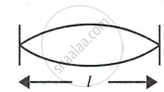
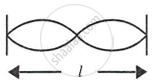
Fig. shows three ways in which a string of length l in an instrument can vibrate.
 |
 |
 |
| (i) | (ii) | (iii) |
- Which of the diagram shows the principle note?
- Which vibration has the frequency four times that of the first?
- Which vibration is of the longest wavelength?
- What is the ratio of the frequency of the vibration in (i) and (ii)?
An observer A fires a gun and another observer B at a distance 1650 m away from A hears its sound. If the speed of sound is 330 m s-1, find the time when B will hear the sound after firing by A.
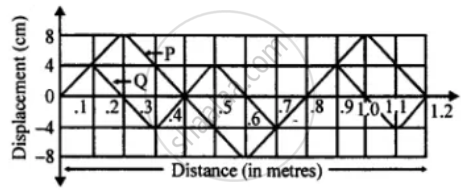
From diagram given below calculate:
- velocity of P and Q
- frequency of P, when frequency of Q is 512 Hz.
Assume that both wave are traveling in same medium.
Note is a sound
Sound travels in the air as ______ wave.
The elastic property of medium is a factor of ______ medium.
