Advertisements
Advertisements
Question
Advertisements
Solution
Frequency of vibrations of a stretched string depends upon:
1. Frequency of the fundamental note of a stretched string is inversely proportional to the length of the vibrating string.
2. Frequency is directly proportional to the square root of the tension of the string.
3. Frequency is inversely proportional to the square root of linear density. That is, mass per unit length of the material of the string. Thinner is the wire, higher is the frequency.
APPEARS IN
RELATED QUESTIONS
How do we produce sound ?
List the measures that you will take when designing a sound-proof room.
In which medium the speed of sound is more: humid air or dry air? Give a reason to your answer.
The speed of sound in air at 0°C is nearly :
What do you understand by the term sound energy?
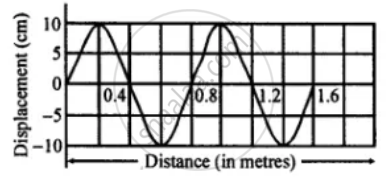
The diagram given below shows a displacement distance graph of a wave. If the velocity of wave is 160 ms-1, calculate:
- wavelength
- frequency
- amplitude.
Sound waves travel very fast in
Match the following
| 1. | Infrasonic | (a) | Compressions |
| 2. | Echo | (b) | 22 kHz |
| 3. | Ultrasonic | (c) | 10 Hz |
| 4. | High-pressure region | (d) | Ultrasonography |
What do you understand by the term echo?
