Advertisements
Advertisements
Question
What conclusion can be obtained from the observation that when the prongs of a sound making tuning fork touch the surface of water in a beaker, the water gets splashed?
Advertisements
Solution
The conclusion from the observation is that the prongs of the tuning fork are vibrating in simple harmonic motion and transmitting energy to the surrounding medium. The prongs move backward and forward continuously to produce compression and rarefaction, which is observed by the splash of water.
APPEARS IN
RELATED QUESTIONS
Explain how sound is produced by your school bell.
Describe an experiment to estimate the speed of sound in air.
Can sound travel through vacuum?
State whether the following statement is true or false :
Sound produced by a vibrating body travels to our ears by the actual movement of air.
Name four ways in which sound can be produced.
How does sound from a sound producing body travel through air to reach our ears? Illustrate your answer with the help of a labelled diagram.
Draw the sketches of two waves A and B such that wave A has twice the wavelength and half the amplitude of wave B.
In the sound wave produced by a vibrating turning fork shown in the diagram, half the wavelength is represented by :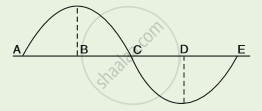
The region in a sound wave, with higher pressure and density, is called ______ and that with low pressure and density is called ______.
How is sound produced in a human larynx and a loudspeaker?
