Advertisements
Advertisements
Question
Explain how sound is produced by your school bell.
Advertisements
Solution
When the school bell vibrates, it forces the adjacent particles in the air to vibrate. This disturbance gives rise to a wave, and when the bell moves forward, it pushes the air in front of it. This creates a region of high pressure known as compression. When the bell moves backwards, it creates a region of low pressure known as rarefaction. As the bell continues to move forward and backward, it produces a series of compressions and reactions. This makes the sound of a bell propagate through the air.
RELATED QUESTIONS
Describe an experiment to estimate the speed of sound in air.
Which of the following cannot transmit sound? Water, Vacuum, Aluminium, Oxygen gas
Name the device which is used to produce sound in laboratory experiments?
What will be the change in the wavelength of a sound wave in air if its frequency is doubled?
Name four ways in which sound can be produced.
A device called oscillator is used to send waves along a stretched string. The string is 20 cm long, and four complete waves fit along its length when the oscillator vibrates 30 times per second. For the waves on the strings.
(a) what is their wavelength?
(b) what is their frequency
(c) what is their speed?
In the sound wave produced by a vibrating turning fork shown in the diagram, half the wavelength is represented by :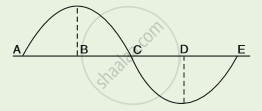
Medium is ______ for generation of sound.
How is sound produced in a human larynx and a loudspeaker?
Match the following:
| Human larynx | Vibrations of metal arms |
| Loudspeaker | Vibrations in air column |
| Jal-Tarang | Vibrations in vocal cords |
| Tuning fork | Vibrations in strings |
| Sitar | Vibrations of screen |
