Advertisements
Advertisements
Question
Describe a simple experiment to show that the prongs of a sound producing tuning fork are vibrating.
Advertisements
Solution
We should fill water in a beaker up to its brim. Now we should touch the surface of water with the prongs of a sound-making tuning fork that has been struck on a hard rubber pad earlier. The prongs of tuning fork that produces sound splashes water. This shows that the prongs of a sound-producing tuning fork are vibrating or rapidly traveling in forward and backward directions.
The prongs of a sound-producing tuning fork splash water, so they are vibrating.
APPEARS IN
RELATED QUESTIONS
What is sound and how is it produced?
Select the correct alternative :
Sound travels the fastest in
Describe an experiment to estimate the speed of sound in air.
A person is listening to a tone of 500 Hz sitting at a distance of 450 m from the source of the sound. What is the time interval between successive compressions from the source?
State whether the following statement is true or false :
Sound produced by a vibrating body travels to our ears by the actual movement of air.
What will be the change in the wavelength of a sound wave in air if its frequency is doubled?
In the sound wave produced by a vibrating turning fork shown in the diagram, half the wavelength is represented by :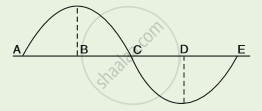
How is sound produced in a human larynx and a loudspeaker?
The vibrations of a simple pendulum are also known as _______.
You and your friend are on the moon. Will you be able to hear any sound produced by your friend?
