Advertisements
Advertisements
Question
In an experiment, Anhad studies sound waves. He sets up a loudspeaker to produce sound as shown below :
Anhad adjusts the signal to the loudspeaker to give a sound of frequency 200 Hz.
(a) What happens to the air in-between Anhad and the loudspeaker ?
(b) Explain how Anhad receives sound in both ears.
Advertisements
Solution
(a) The air in between Anhad and speaker vibrates with the frequency of 200 Hz. Sound is a longitudinal wave, so successive compression and rarefaction is formed between Anhad and the speaker.
(b) Anhad receives sound in the right ear by the sound waves transmitted directly from the loudspeaker, and in his left ear, he receives sound from sound waves reflected from the classroom wall.
APPEARS IN
RELATED QUESTIONS
Write true or false for a given statement.
Sound can only be produced by vibrating bodies.
What are wavelength, frequency, time period and amplitude of a sound wave?
What is the vacuum? Explain why, sound cannot travel through vacuum?
In fig. shows a snap shot of a wave from of frequency 50 Hz in a string. The numbers in the diagram represents distance in centimeters. Fpr the wave motion, find
(a) Wavelength,
(b) Amplitude,
(c) Velocity.
The speed of light in air is :
200 waves pass through a point in one second. Calculate the time period of wave.
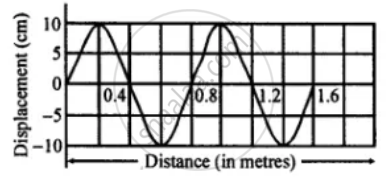
The diagram given below shows a displacement distance graph of a wave. If the velocity of wave is 160 ms-1, calculate:
- wavelength
- frequency
- amplitude.
Why is the ceiling and wall behind the stage of good conference halls or concert halls made curved?
