Advertisements
Advertisements
Question
Advertisements
Solution
Characteristics of wave motion:
1. Wave motion can be produced only in a medium having elasticity and inertia.
2. When energy is given to any part of a medium, disturbance is produced in it by repeated periodic motion of the particles about their equilibrium positions.
3. During wave motion, no matter is transferred. It is only the energy that gets transferred.
4. The velocity of the wave relative to the medium depends only on the nature of the medium and not on the nature or motion of source of disturbance.
5. The velocity of the wave is different from the velocity with which the particles of the medium vibrate about their equilibrium positions.
6. Energy gets transferred from one particle of a medium to the next particle in a fixed interval of time.
7. The energy associated with the wave is the kinetic and potential energy of the matter.
APPEARS IN
RELATED QUESTIONS
What are ultrasonics? Can you hear the ultrasonic sound?
Describe an experiment to show the production of sound having low and high pitch.
'Note' is a sound :
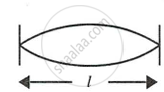
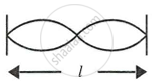
Fig. shows three ways in which a string of length l in an instrument can vibrate.
 |
 |
 |
| (i) | (ii) | (iii) |
- Which of the diagram shows the principle note?
- Which vibration has the frequency four times that of the first?
- Which vibration is of the longest wavelength?
- What is the ratio of the frequency of the vibration in (i) and (ii)?
A continuous progressive transverse wave of frequency 8 Hz moves across the surface of a ripple tank
With reference to the frequency, describe the movement of water on the surface
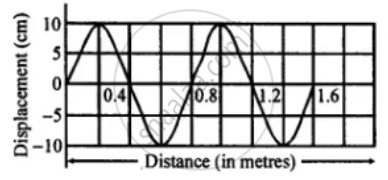
The diagram given below shows a displacement distance graph of a wave. If the velocity of wave is 160 ms-1, calculate:
- wavelength
- frequency
- amplitude.
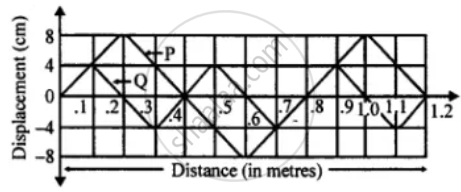
From diagram given below calculate:
- velocity of P and Q
- frequency of P, when frequency of Q is 512 Hz.
Assume that both wave are traveling in same medium.
Sound is a ______ wave and needs a material medium to travel.
Give scientific reasons.
In earlier times, people used to listen for the arrival of a distant train by putting their ear to the rail.
