Advertisements
Advertisements
प्रश्न
In an experiment, Anhad studies sound waves. He sets up a loudspeaker to produce sound as shown below :
Anhad adjusts the signal to the loudspeaker to give a sound of frequency 200 Hz.
(a) What happens to the air in-between Anhad and the loudspeaker ?
(b) Explain how Anhad receives sound in both ears.
Advertisements
उत्तर
(a) The air in between Anhad and speaker vibrates with the frequency of 200 Hz. Sound is a longitudinal wave, so successive compression and rarefaction is formed between Anhad and the speaker.
(b) Anhad receives sound in the right ear by the sound waves transmitted directly from the loudspeaker, and in his left ear, he receives sound from sound waves reflected from the classroom wall.
APPEARS IN
संबंधित प्रश्न
What do you mean by a vibratory motion?
List the measures that you will take when designing a sound-proof room.
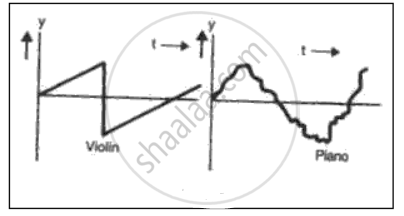
In fig. 2 two musical notes of the same pitch and same loudness are played on a violin and on a piano. Their wave forms are as shown in the diagram below. Explain why the wave patterns are different.
State the speed of (i) light and (ii) sound in air?
The separation between two consecutive crests in a transverse wave is 100 m. If wave velocity is 20 m s-1, find the frequency of wave.
Two tuning forks A and B of frequencies 256 Hz and 192 Hz respectively are vibrated in air. If the wavelength of A is 1.25 m, calculate the wavelength produced by B.
Explain how the principle of echo is used by the dolphin to locate small fish as its prey.
What types of medium are required for sound to travel?
What do you understand by the term echo?
