Advertisements
Advertisements
Question
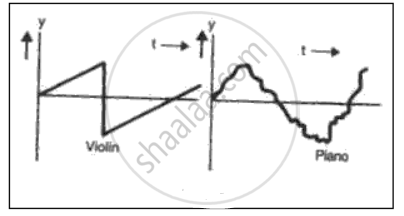
In fig. 2 two musical notes of the same pitch and same loudness are played on a violin and on a piano. Their wave forms are as shown in the diagram below. Explain why the wave patterns are different.
Advertisements
Solution
The number, and nature of harmonics and overtones present, affects the quality of sound. The different combinations of number and nature of harmonics and overtones present in the 'notes' gives these different wave patterns.
APPEARS IN
RELATED QUESTIONS
What is the difference between a compression and a rarefaction in a sound wave? Illustrate your answer with a sketch.
Which of the following can produce longitudinal waves as well as transverse waves under different conditions?
At 20°C, the minimum distance of a person from a sound reflecting surface to hear an echo is :
What is echolocation? How do animals make use of this phenomenon?
Give an example to show that light travels faster than sound?
Sound is a ______ wave and needs a material medium to travel.
Rapid back and forth motion of a particle about its mean position is called _____.
