Advertisements
Advertisements
Question
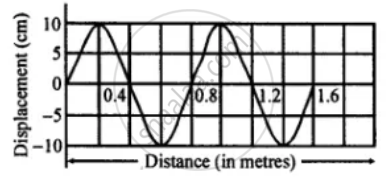
The diagram given below shows a displacement distance graph of a wave. If the velocity of wave is 160 ms-1, calculate:
- wavelength
- frequency
- amplitude.
Advertisements
Solution
(i) Wavelength (λ) = Distance between two consecutive crests
= 1.0 - 0.2 = 0.8 m
(ii) Frequency (f) = `"v"/lambda`
Wavelength (v) = 160ms-1 ...(given)
∴ f = `160/0.8 = 200` Hz
(iii) Amplitude = Maximum displacement from mean position = 10 cm
APPEARS IN
RELATED QUESTIONS
Fill in the blank.
________ produces a sensation in ears.
Name the type of waves produced when a tuning fork is struck in air.
Complete the following sentences :
Sound cannot travel through __________, but it requires a ___________.
The speed of sound is more in hydrogen than in nitrogen. Is this statement true? Give a reason for your answer.
Draw a displacement-time graph for water wave.
Sound travels in the air as ______ wave.
The elastic property of medium is a factor of ______ medium.
What is a wave?
