Advertisements
Advertisements
प्रश्न
What is the difference between a compression and a rarefaction in a sound wave? Illustrate your answer with a sketch.
Advertisements
उत्तर
A longitudinal wave consists of successive compression and rarefaction that is formed due to continuous to and fro motion of a vibrating object.
A compression is that part of a longitudinal wave in which the particles of the medium are closer to one another than they normally are, and there is a momentary reduction in volume of the medium. It is a region of high pressure and high density.
A rarefaction is that part of a longitudinal wave in which the particles of the medium are farther apart than normal, and there is a momentary increase in the volume of the medium. It is a region of low pressure and low density.
APPEARS IN
संबंधित प्रश्न
How can the pitch of sound produced in a piano be changed ?
What causes sound?
The speed of sound is more in hydrogen than in nitrogen. Is this statement true? Give a reason for your answer.
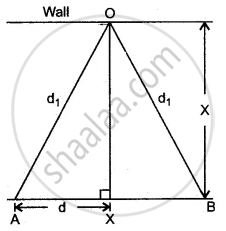
A cannon is fired at A (see diagram). An observer at B hears two sounds. The first sound is heard after 1 second and the second 3s after the observer sees the flash. (Velocity of sound = 340 ms−1)
(i) Why does the observer see the flash before he hears the sound?
(ii) Calculate the distance x between the observer and the wall.
Select the correct option:
In the region of compression or rarefaction, in a longitudinal wave, the physical quantity which does not change is:
Is sound a form of energy?
A person hearing at one end of a long metal bar hears two distinct sounds when the other end is struck with a stone. Explain, giving scientific reasons
Describe with diagram, how compressions and rarefactions are produced.
What happens to the speed of sound when it gases from a solid to a gaseous state?
