Advertisements
Advertisements
Question
Differentiate between the following:
Light and sound waves.
Advertisements
Solution
| Light waves | Sound waves |
| 1. These are electromagnetic waves. | 1. These are mechanical waves. |
| 2. They can travel in vacuum. | 2. They re qui re a materia I medium for propagation. |
| 3. The speed of light waves is very high ( = 3 x 10⁸ m/s in air). | 3. The speed of sound waves is low ( =3 30 m/s in air). |
| 4. The wavelength of the light waves (visible) is very small, of the order of 10-6 m. | 4. The wavelength of sound waves is in the range of 10-2 m to lOm. |
| 5. These waves are transverse. | 5. These waves are lonaitud ina I waves. |
APPEARS IN
RELATED QUESTIONS
In the diagram below, A, B, C, D are four pendulums suspended from the same elastic string PQ. The lengths of A and C are equal to each other, while the length of pendulum B is smaller than that of D. Pendulum A is set into a mode of vibrations.
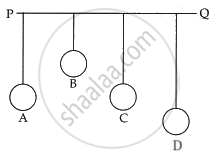
- Name the type of vibrations taking place in pendulums B and D.
- What is the state of pendulum C?
- State the reason for the type of vibrations in pendulums B and C.
The adjacent diagram shows three different modes of vibrations P, Q and R of the same string.
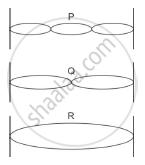
(i) Which vibration will produce a louder sound and why?
(ii) The sound of which string will have maximum shrillness?
(iii) State the ratio of wavelengths of P and R.
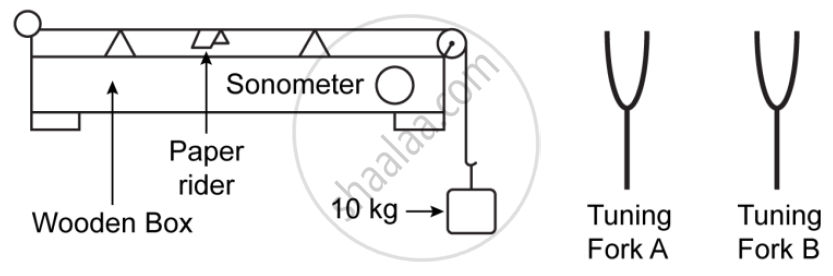
The diagram above shows a wire stretched over a sonometer. Stems of two vibrating tuning forks A and Bare touched to the wooden box of the sonometer. It is observed that the paper rider (a small piece of paper folded at the centre) present on the wire flies off when the stem of vibrating tuning fork B is touched to the wooden box but the paper just vibrates when the stem of vibrating tuning fork A is touched to the wooden box.
1) Name the phenomenon when the paper rider just vibrates.
2) Name the phenomenon when the paper rider flies off.
3) Why does the paper rider fly off when the stem of tuning fork B is touched to the box?
How do you tune your radio set to a particular station ? Name the phenomenon involved in doing so and define it.
Which characteristic of sound makes it possible to recognize a person by his voice without seeing him?
Differentiate between the following:
Free and forced vibrations.
Differentiate between the following:
Radio waves and light waves.
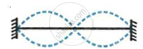
The diagram below shows three different modes of vibration P, Q and R of the same string of a given length.
 |
 |
 |
| P | Q | R |
- Which vibration will produce a louder sound and why?
- Which vibration will produce sound of maximum shrillness (or pitch) and why?
- What is the ratio of wavelength of vibrations P and R?
When a tuning fork, struck by a rubber pad, is held over a length of the air column in a tube, it produces a loud sound for a fixed length of the air column. Name the above phenomenon. How does the frequency of the loud sound compare with that of the tuning fork? State the unit for measuring loudness.
Describe a simple experiment to illustrate the phenomenon of resonance and explain it.
