Advertisements
Advertisements
Question
Advertisements
Solution
Sounds can be roughly divided into two categories: (i) music, and (ii) noise.
Regularity, contrivity and rapidity make musical sounds different from a noise. The distinction between music and noise is not very sharp; it is subjective.
| Music | Noise |
| 1. It is pleasant, smooth and agreeable to the ear. | 1. It is harsh, discordant and displeasing to the ear. |
| 2. It is produced by the vibrations which are periodic. | 2. It is produced by an irregular succession of disturbances. |
| 3. All the component waves are similar without any sudden change in their wavelength and amplitude | 3. The component wave chanqes their character suddenly and they are of short duration.. |
| 4. The sound level is low (below 30 dB). | 4. The sound level is hiah (above 120 dB). |
APPEARS IN
RELATED QUESTIONS
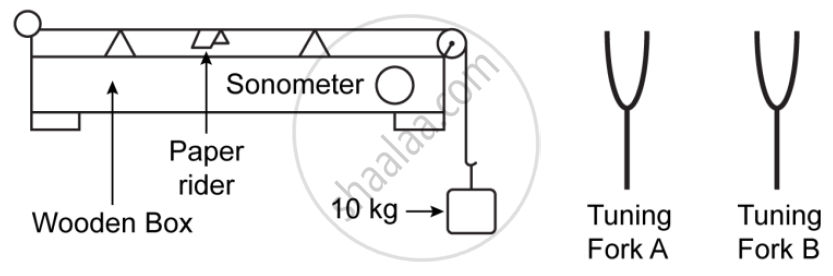
The diagram above shows a wire stretched over a sonometer. Stems of two vibrating tuning forks A and Bare touched to the wooden box of the sonometer. It is observed that the paper rider (a small piece of paper folded at the centre) present on the wire flies off when the stem of vibrating tuning fork B is touched to the wooden box but the paper just vibrates when the stem of vibrating tuning fork A is touched to the wooden box.
1) Name the phenomenon when the paper rider just vibrates.
2) Name the phenomenon when the paper rider flies off.
3) Why does the paper rider fly off when the stem of tuning fork B is touched to the box?
Differentiate between the forced and resonant vibrations.
A vibrating tuning fork, held over an air column of a given length with its one end closed, produces a loud audible sound. Name the phenomenon responsible for it and explain the observation.
Which characteristic of sound makes it possible to recognize a person by his voice without seeing him?
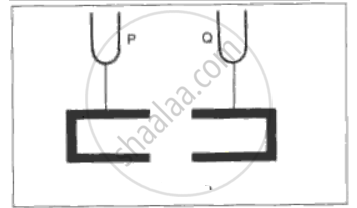
In fig. shows two tuning forks P and Q of the same frequency mounted on separate sound boxes with their open ends facing each other. The fork A is set into vibration. (i) Describe your observation. (ii) State the principle illustrated by this experiment.
What do you mean by resonance? When does resonance occur?
Explain why are soldiers asked to walk out of step while crossing bridges?
Explain a person walking past a railway line, in the middle of night hears a ringing sound along with the sound of his footsteps.
What are the factors that affect the frequency of a vibrating string and how do they affect the frequency?
