Advertisements
Advertisements
Question
Distinguish between the free (or natural) and forced vibrations.
Advertisements
Solution
| Natural Vibration | Forced Vibration | |
| i. | An object's natural vibrations are its inherent vibrations, which occur at a consistent amplitude and frequency. |
Forced vibrations are those that occur as a result of being subjected to a periodic external force. |
| ii. | The amplitude changes with time. | Amplitude doesn't change throughout time. |
| iii. | The body's intrinsic frequency causes it to vibrate. | Does not move at its own natural frequency, but instead learns to deduce its own. |
APPEARS IN
RELATED QUESTIONS
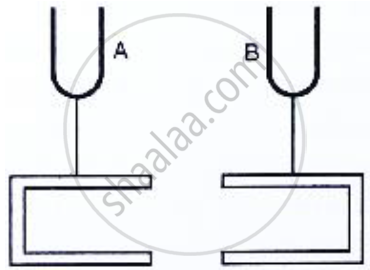
In following figure shows two tuning forks A and B of the same frequency mounted on two separate sound boxes with their open ends facing each other. The fork A is set into vibration.
- Describe your observation.
- State the principle illustrated by this experiment.
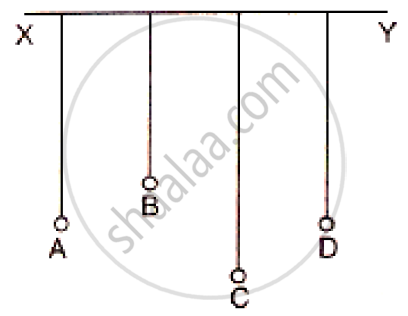
In following figure shows A, B, C and D are four pendulums suspended from the same elastic string XY. Lengths of pendulum A and D are equal, while the length of pendulum B is smaller and the pendulum C is longer. The pendulum A is set into vibration.
(a) what is your observation? (b) Give reason for your observation.
When a troop crosses a suspension bridge, the soldiers are asked to break steps. Explain the reason.
When a body vibrates under a periodic force, the vibrations of the body are ______.
Which characteristic of sound makes it possible to recognize a person by his voice without seeing him?
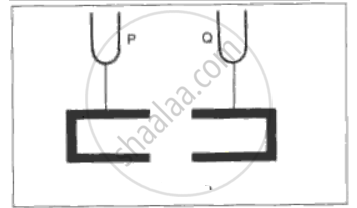
In fig. shows two tuning forks P and Q of the same frequency mounted on separate sound boxes with their open ends facing each other. The fork A is set into vibration. (i) Describe your observation. (ii) State the principle illustrated by this experiment.
State two ways in which resonance differs from forced vibrations.
The rearview mirror of a motorbike starts vibrating violently at some particular speed of the motorbike, what could be done to stop the violent vibrations.
Explain why does the rear mirror of a motorbike start Vibrating Violently, at some particular speed of motorbike?
A string stretched between its ends is made to vibrate by placing the stem of a vibrating tuning fork at its one end. State three ways how you will increase the frequency of note produced by the string.
