Advertisements
Advertisements
Question
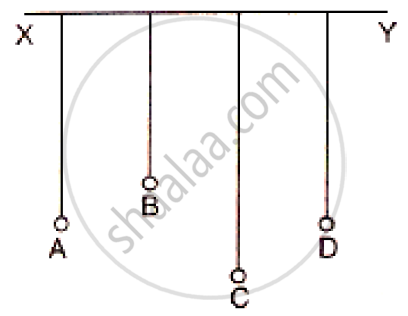
In following figure shows A, B, C and D are four pendulums suspended from the same elastic string XY. Lengths of pendulum A and D are equal, while the length of pendulum B is smaller and the pendulum C is longer. The pendulum A is set into vibration.
(a) what is your observation? (b) Give reason for your observation.
Advertisements
Solution
(a) Set the pendulum A into vibration by displacing it to one side, normal to its length. It is observed that pendulum D also starts vibrating initially with a small amplitude and ultimately it acquires the same amplitude as the pendulum A initially had. When the amplitude of the pendulum D becomes maximum, the amplitude of the pendulum A becomes minimum since the total energy is constant. After some time the amplitude of the pendulum D will decreases and amplitude of A increases. The exchange of energy takes place only between the pendulums A and D because their natural frequencies are same. The pendulums B and C also vibrate, but with very small amplitudes.
(b) The vibrations produced in pendulum A are communicated as forced vibrations to the other pendulums B, C and D through XY. The pendulums B and C remain in the state of forced vibrations, while the pendulum D comes in the state of resonance.
RELATED QUESTIONS
In the diagram below, A, B, C, D are four pendulums suspended from the same elastic string PQ. The length of A and C are equal to each other while the length of pendulum B is smaller than that of D. Pendulum A is set into a mode of vibrations
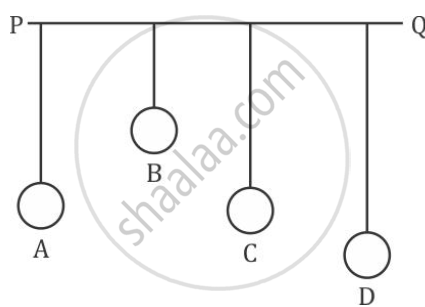
1) Name the type of vibrations taking place in pendulums B and D?
2) What is the state of pendulum C?
3) State the reason for the type of vibrations in pendulum B and C.
The adjacent diagram shows three different modes of vibrations P, Q and R of the same string.
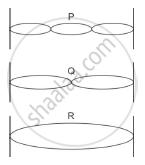
(i) Which vibration will produce a louder sound and why?
(ii) The sound of which string will have maximum shrillness?
(iii) State the ratio of wavelengths of P and R.
Distinguish between the free (or natural) and forced vibrations.
In following figure shows two tuning forks A and B of the same frequency mounted on two separate sound boxes with their open ends facing each other. The fork A is set into vibration.
- Describe your observation.
- State the principle illustrated by this experiment.

A vibrating tuning fork, held over an air column of a given length with its one end closed, produces a loud audible sound. Name the phenomenon responsible for it and explain the observation.
A tuning fork of frequency 256 Hz will resonate with another tuning fork of frequency:
What do you mean by resonance? When does resonance occur?
Explain a person walking past a railway line, in the middle of night hears a ringing sound along with the sound of his footsteps.
What are the factors that affect the frequency of a vibrating string and how do they affect the frequency?
