Advertisements
Advertisements
Question
Define the Resonance phenomenon?
Advertisements
Solution
Resonance: When the frequency of an externally applied periodic force on a body is equal to its natural frequency, the body readily begins to vibrate with an increased amplitude. This phenomenon is known as resonance.
APPEARS IN
RELATED QUESTIONS
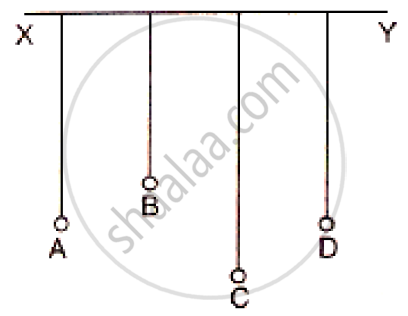
In following figure shows A, B, C and D are four pendulums suspended from the same elastic string XY. Lengths of pendulum A and D are equal, while the length of pendulum B is smaller and the pendulum C is longer. The pendulum A is set into vibration.
(a) what is your observation? (b) Give reason for your observation.
Why are the stringed instruments like guitar provided with a hollow sound box?
Differentiate between the following:
Free and forced vibrations.
On keeping the stem of a vibrating tuning fork on the surface of a table, a loud sound is heard. Give reason.
Explain why stringed musical instruments, like the guitar, are provided with a hollow box.
Explain why are soldiers asked to walk out of step while crossing bridges?
A string stretched between its ends is made to vibrate by placing the stem of a vibrating tuning fork at its one end. State three ways how you will increase the frequency of note produced by the string.
Explain free and forced vibrations. Give an experimental arrangement to illustrate the phenomenon of resonance.
Describe a simple experiment to illustrate the phenomenon of resonance and explain it.
