Advertisements
Advertisements
Question
Explain a tuning fork (vibrating) is held close to ear. One hears a faint sound. The same vibrating tuning fork is placed on table, such that its handle is in contact with table, one hears a loud sound.
Advertisements
Solution
When the tuning fork is held close to ear, then small amount of air is disturbed and hence sound is faint. When the handle of the vibrating tuning fork is held aganist table, it makes the table top to vibrate, with forced vibrations. As the table top has a larger surface area, therefore large volume of air is set into vibrations, thereby producing a loud sound.
APPEARS IN
RELATED QUESTIONS
Name the phenomenon involved in tunning a radio set to a particular station.
Why is a loud sound heard at resonance?
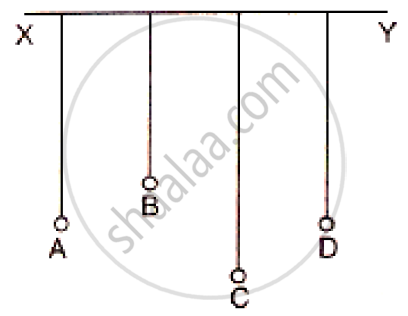
In following figure shows A, B, C and D are four pendulums suspended from the same elastic string XY. Lengths of pendulum A and D are equal, while the length of pendulum B is smaller and the pendulum C is longer. The pendulum A is set into vibration.
(a) what is your observation? (b) Give reason for your observation.
In following figure shows A, B , C and D represent test tube each of height 20 cm which are filled with water up to heights of 12 cm, 14 cm, 16cm and 18cm respectively. If a vibrating tuning fork is placed over the mouth if test tube D, a loud sound is heard.

- Describe the observations with the tubes A, B and C when the vibrating tuning fork is placed over the mouth of these tubes.
- Give the reason for your observation in each case.
- State the principle illustrated by the above experiment.
A tuning fork of frequency 256 Hz will resonate with another tuning fork of frequency:
Give two examples of forced vibrations.
When a tuning fork, struck by a rubber pad, is held over a length of the air column in a tube, it produces a loud sound for a fixed length of the air column. Name the above phenomenon. How does the frequency of the loud sound compare with that of the tuning fork? State the unit for measuring loudness.
Explain free and forced vibrations. Give an experimental arrangement to illustrate the phenomenon of resonance.
When the stem of vibrating tuning fork is pressed on a table, the tabletop starts vibrating. These vibrations are definitely an example of ______.
