Advertisements
Advertisements
Question
In following figure shows A, B , C and D represent test tube each of height 20 cm which are filled with water up to heights of 12 cm, 14 cm, 16cm and 18cm respectively. If a vibrating tuning fork is placed over the mouth if test tube D, a loud sound is heard.

- Describe the observations with the tubes A, B and C when the vibrating tuning fork is placed over the mouth of these tubes.
- Give the reason for your observation in each case.
- State the principle illustrated by the above experiment.
Advertisements
Solution
- No loud sound is heard with the tubes A and C, but a loud sound is heard with the tube B.
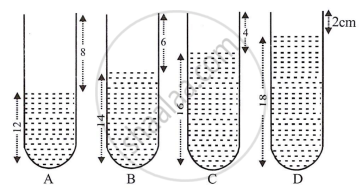
- While tubes A and C do not experience resonance with their air columns, tube B does. The air column length in tube D is 20 – 18 = 2 cm, while in tube B it is 20 – 14 = 6 cm, which is three times the length in tube D. Consequently, the frequency of vibrations in both tubes is identical. Contrarily, air column vibrations in tubes A and C do not have the same frequency as those in tube B.
- Resonance happens when the air column vibration frequency is exactly the same as the tuning fork vibration frequency.
APPEARS IN
RELATED QUESTIONS
What are forced vibrations?
In following figure shows two tuning forks A and B of the same frequency mounted on two separate sound boxes with their open ends facing each other. The fork A is set into vibration.
- Describe your observation.
- State the principle illustrated by this experiment.

A vibrating tuning fork, held over an air column of a given length with its one end closed, produces a loud audible sound. Name the phenomenon responsible for it and explain the observation.
When a troop crosses a suspension bridge, the soldiers are asked to break steps. Explain the reason.
A tuning fork of frequency 256 Hz will resonate with another tuning fork of frequency:
On keeping the stem of a vibrating tuning fork on the surface of a table, a loud sound is heard. Give reason.
Explain a person walking past a railway line, in the middle of night hears a ringing sound along with the sound of his footsteps.
What do you understand by free (or natural) vibrations?
What are the factors that affect the frequency of a vibrating string and how do they affect the frequency?
