Advertisements
Advertisements
प्रश्न
In following figure shows A, B , C and D represent test tube each of height 20 cm which are filled with water up to heights of 12 cm, 14 cm, 16cm and 18cm respectively. If a vibrating tuning fork is placed over the mouth if test tube D, a loud sound is heard.
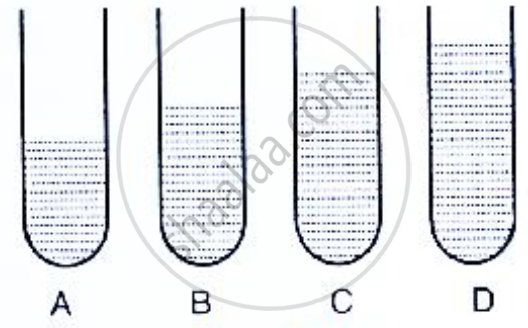
- Describe the observations with the tubes A, B and C when the vibrating tuning fork is placed over the mouth of these tubes.
- Give the reason for your observation in each case.
- State the principle illustrated by the above experiment.
Advertisements
उत्तर
- No loud sound is heard with the tubes A and C, but a loud sound is heard with the tube B.
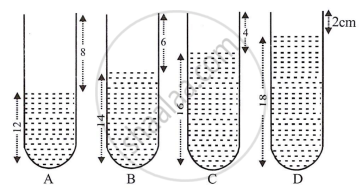
- While tubes A and C do not experience resonance with their air columns, tube B does. The air column length in tube D is 20 – 18 = 2 cm, while in tube B it is 20 – 14 = 6 cm, which is three times the length in tube D. Consequently, the frequency of vibrations in both tubes is identical. Contrarily, air column vibrations in tubes A and C do not have the same frequency as those in tube B.
- Resonance happens when the air column vibration frequency is exactly the same as the tuning fork vibration frequency.
APPEARS IN
संबंधित प्रश्न
Name the phenomenon involved in tunning a radio set to a particular station.
What are mechanical waves?
A tuning fork of frequency 256 Hz will resonate with another tuning fork of frequency:
In Fig. A, B, C and D are four pendulums suspended from the same elastic string XY. The lengths of pendulum A and D are equal, while the length of pendulum B is shorter and of the pendulum C is longer. Pendulum A is set into vibrations.

- What is your observation about the vibrations of pendulum D?
- Give reason for your observation in part (a).
- What type of vibrations take place in pendulums Band C?
- Give reason for the answer in part (c).
On keeping the stem of a vibrating tuning fork on the surface of a table, a loud sound is heard. Give reason.
Give two examples of forced vibrations.
State two ways in which resonance differs from forced vibrations.
A string stretched between its ends is made to vibrate by placing the stem of a vibrating tuning fork at its one end. State three ways how you will increase the frequency of note produced by the string.
