Advertisements
Advertisements
प्रश्न
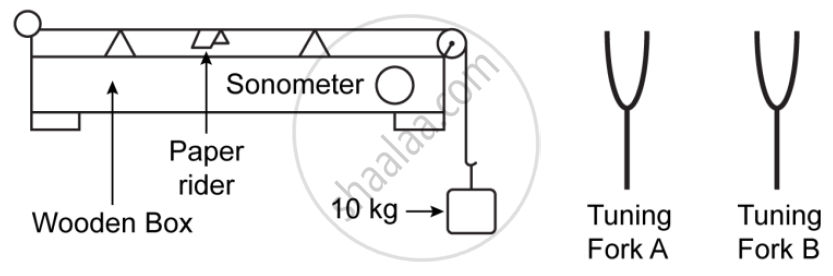
The diagram above shows a wire stretched over a sonometer. Stems of two vibrating tuning forks A and Bare touched to the wooden box of the sonometer. It is observed that the paper rider (a small piece of paper folded at the centre) present on the wire flies off when the stem of vibrating tuning fork B is touched to the wooden box but the paper just vibrates when the stem of vibrating tuning fork A is touched to the wooden box.
1) Name the phenomenon when the paper rider just vibrates.
2) Name the phenomenon when the paper rider flies off.
3) Why does the paper rider fly off when the stem of tuning fork B is touched to the box?
Advertisements
उत्तर
1) Vibration (The frequency of fork is close to the natural frequencies of vibrating wire).
2) Resonance
3) The paper rider flies off because the natural frequency of vibration of wire matches the frequency of the tuning fork.
APPEARS IN
संबंधित प्रश्न
Give one example to illustrate forced vibrations.
A vibrating tuning fork, held over an air column of a given length with its one end closed, produces a loud audible sound. Name the phenomenon responsible for it and explain the observation.
Why are the stringed instruments like guitar provided with a hollow sound box?
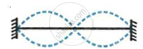
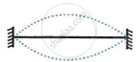
The diagram below shows three different modes of vibration P, Q and R of the same string of a given length.
 |
 |
 |
| P | Q | R |
- Which vibration will produce a louder sound and why?
- Which vibration will produce sound of maximum shrillness (or pitch) and why?
- What is the ratio of wavelength of vibrations P and R?
What do you mean by resonance? When does resonance occur?
When acoustic resonance takes place, a loud sound is heard. Why does this happen? Explain.
A vibrating tuning fork is placed over the mouth of a burette filled with water. The tap is opened and the water level gradually falls. It is observed that the sound becomes the loudest for a particular length of the air column. What is the name of the phenomenon taking place when this happens? Why does the sound become the loudest?
What do you understand by free vibrations of a body? Draw a displacement-time graph to represent them. Given one example.
