Advertisements
Advertisements
प्रश्न
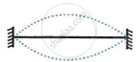
The diagram below shows three different modes of vibration P, Q and R of the same string of a given length.
 |
 |
 |
| P | Q | R |
- Which vibration will produce a louder sound and why?
- Which vibration will produce sound of maximum shrillness (or pitch) and why?
- What is the ratio of wavelength of vibrations P and R?
Advertisements
उत्तर
(a) R will produce maximum sound because it has maximum amplitude.
(b) P will produce maximum shrillness because it has a maximum frequency.
(c) Let's suppose the string has length l
Then wavelength of P = `"2 l"/3`
Wavelength of R = 2 l
∴ `lambda_"P"/lambda_"R" = ("2 l"/3)/"2 l" = 1/3`
∴ λp : λR = 1 : 3
APPEARS IN
संबंधित प्रश्न
In the diagram below, A, B, C, D are four pendulums suspended from the same elastic string PQ. The lengths of A and C are equal to each other, while the length of pendulum B is smaller than that of D. Pendulum A is set into a mode of vibrations.
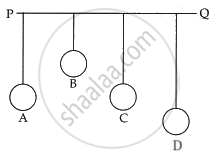
- Name the type of vibrations taking place in pendulums B and D.
- What is the state of pendulum C?
- State the reason for the type of vibrations in pendulums B and C.
Give one example to illustrate forced vibrations.
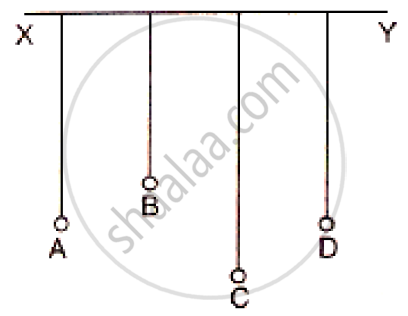
In following figure shows A, B, C and D are four pendulums suspended from the same elastic string XY. Lengths of pendulum A and D are equal, while the length of pendulum B is smaller and the pendulum C is longer. The pendulum A is set into vibration.
(a) what is your observation? (b) Give reason for your observation.
How do you tune your radio set to a particular station ? Name the phenomenon involved in doing so and define it.
Which characteristic of sound makes it possible to recognize a person by his voice without seeing him?
In fig. shows two tuning forks P and Q of the same frequency mounted on separate sound boxes with their open ends facing each other. The fork A is set into vibration. (i) Describe your observation. (ii) State the principle illustrated by this experiment.

In Fig. A, B, C and D are four pendulums suspended from the same elastic string XY. The lengths of pendulum A and D are equal, while the length of pendulum B is shorter and of the pendulum C is longer. Pendulum A is set into vibrations.

- What is your observation about the vibrations of pendulum D?
- Give reason for your observation in part (a).
- What type of vibrations take place in pendulums Band C?
- Give reason for the answer in part (c).
Explain Why are stringed musical instruments provided with large sound boxes?
What do you understand by free vibrations of a body? Draw a displacement-time graph to represent them. Given one example.
