Advertisements
Advertisements
प्रश्न
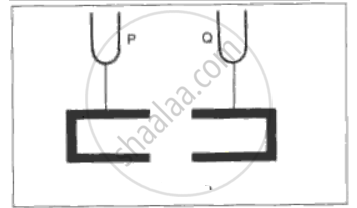
In fig. shows two tuning forks P and Q of the same frequency mounted on separate sound boxes with their open ends facing each other. The fork A is set into vibration. (i) Describe your observation. (ii) State the principle illustrated by this experiment.
Advertisements
उत्तर
(i) If the tuning fork A is set into vibration, the other fork B also starts vibrating and a loud sound is heard.
The vibrating tuning fork A produces the forced vibrations in the air column of its sound box. These vibrations are of large amplitude because of large surface area of the air in the sound box and they are communicated to the sound box of the fork B. The air column of B starts vibrating with the frequency of fork A. Since the frequency of these vibrations is same as the natural frequency of the fork B, the fork B starts vibrating due to resonance.
(ii) The principle of 'resonance' is illustrated by this experiment.
Statement: When the frequency of the forced vibration is equal to the natural frequency of a body nearby or an integer multiple of it then the body vibrates with a large amplitude. This phenomenon is called resonance.
APPEARS IN
संबंधित प्रश्न
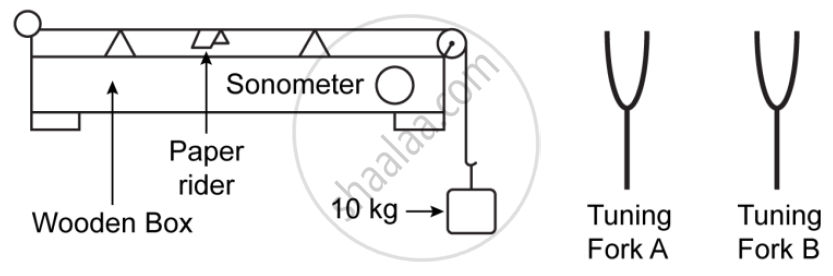
The diagram above shows a wire stretched over a sonometer. Stems of two vibrating tuning forks A and Bare touched to the wooden box of the sonometer. It is observed that the paper rider (a small piece of paper folded at the centre) present on the wire flies off when the stem of vibrating tuning fork B is touched to the wooden box but the paper just vibrates when the stem of vibrating tuning fork A is touched to the wooden box.
1) Name the phenomenon when the paper rider just vibrates.
2) Name the phenomenon when the paper rider flies off.
3) Why does the paper rider fly off when the stem of tuning fork B is touched to the box?
How does the medium affect the amplitude of free/natural vibrations of a body?
The rearview mirror of a motorbike starts vibrating violently at some particular speed of the motorbike, what could be done to stop the violent vibrations.
Explain a tuning fork (vibrating) is held close to ear. One hears a faint sound. The same vibrating tuning fork is placed on table, such that its handle is in contact with table, one hears a loud sound.
A vibrating tuning fork is placed over the mouth of a burette filled with water. The tap is opened and the water level gradually falls. It is observed that the sound becomes the loudest for a particular length of the air column. What is the name of the phenomenon taking place when this happens? Why does the sound become the loudest?
Explain a person walking past a railway line, in the middle of night hears a ringing sound along with the sound of his footsteps.
What do you understand by free (or natural) vibrations?
