Advertisements
Advertisements
प्रश्न
A bucket kept under a running tap is getting filled with water. A person sitting at a distance is able to get an idea when the bucket is about to be filled.
(i) What change takes place in the sound to give this idea?
(ii) What causes the change in the sound?
Advertisements
उत्तर
(i) As the bucket is filled the sound gradually increases.
(ii) Frequency ∝ 1/length; Resonance takes place.
APPEARS IN
संबंधित प्रश्न
Why is a loud sound heard at resonance?
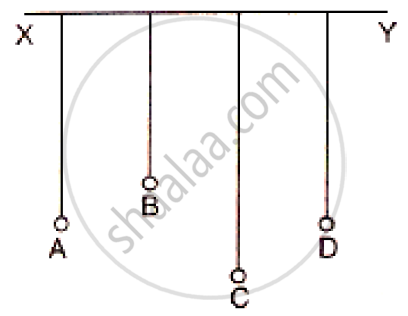
In following figure shows A, B, C and D are four pendulums suspended from the same elastic string XY. Lengths of pendulum A and D are equal, while the length of pendulum B is smaller and the pendulum C is longer. The pendulum A is set into vibration.
(a) what is your observation? (b) Give reason for your observation.
A tuning fork of frequency 256 Hz will resonate with another tuning fork of frequency:
On keeping the stem of a vibrating tuning fork on the surface of a table, a loud sound is heard. Give reason.
Explain why stringed musical instruments, like the guitar, are provided with a hollow box.
The rearview mirror of a motorbike starts vibrating violently at some particular speed of the motorbike. What is the name of the phenomenon taking place? Why does the happen?
A string stretched between its ends is made to vibrate by placing the stem of a vibrating tuning fork at its one end. State three ways how you will increase the frequency of note produced by the string.
What do you understand by forced vibrations?
When the stem of vibrating tuning fork is pressed on a table, the tabletop starts vibrating. These vibrations are definitely an example of ______.
