Advertisements
Advertisements
प्रश्न
What do you understand by free (or natural) vibrations?
Explain natural vibrations.
Advertisements
उत्तर
Any object when slightly disturbed from its position of rest or equilibrium vibrates with its own period irrespective of its size or shape, is said to make vibrations. The time period of said vibrations is called the natural time period and the frequency is called the natural frequency. In the absence of any resistance such as air, the amplitude of free vibration remains constant.
APPEARS IN
संबंधित प्रश्न
In the diagram below, A, B, C, D are four pendulums suspended from the same elastic string PQ. The lengths of A and C are equal to each other, while the length of pendulum B is smaller than that of D. Pendulum A is set into a mode of vibrations.
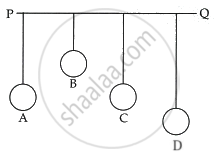
- Name the type of vibrations taking place in pendulums B and D.
- What is the state of pendulum C?
- State the reason for the type of vibrations in pendulums B and C.
Resonance is a special case of ______ vibrations, when frequency of the driving force is ______ natural frequency of the body.
In following figure shows A, B , C and D represent test tube each of height 20 cm which are filled with water up to heights of 12 cm, 14 cm, 16cm and 18cm respectively. If a vibrating tuning fork is placed over the mouth if test tube D, a loud sound is heard.

- Describe the observations with the tubes A, B and C when the vibrating tuning fork is placed over the mouth of these tubes.
- Give the reason for your observation in each case.
- State the principle illustrated by the above experiment.
When a troop crosses a suspension bridge, the soldiers are asked to break steps. Explain the reason.
Two pendulums C and D are suspended from a wire as shown in the figure give below. Pendulum C is made to oscullate by displaying it from its mean position. It is seen that D also starts oscillating.
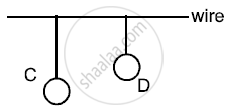
(i) Name the type of oscillation, C will execute.
(ii) Name the type of oscillation, D will execute.
(iii) If the length of D is made equal to C then what difference will you notice in the oscillations of D ?
(iv) What is the name of the phenomenon when the length of D is made equal to C ?
Explain why stringed musical instruments, like the guitar, are provided with a hollow box.
State two ways in which resonance differs from forced vibrations.
Explain a tuning fork (vibrating) is held close to ear. One hears a faint sound. The same vibrating tuning fork is placed on table, such that its handle is in contact with table, one hears a loud sound.
Explain Why are stringed musical instruments provided with large sound boxes?
Explain free and forced vibrations. Give an experimental arrangement to illustrate the phenomenon of resonance.
