Advertisements
Advertisements
प्रश्न
State two ways in which resonance differs from forced vibrations.
Advertisements
उत्तर
(i) In resonance it is necessary that the frequency of externally applied force should be equal to the natural frequency of the body whereas, it is not necessary for forced vibrations.
(ii) In forced oscillations, the amplitude of oscillations is small whereas, in resonance the amplitude of vibration is large.
APPEARS IN
संबंधित प्रश्न
Give one example to illustrate forced vibrations.
Resonance is a special case of ______ vibrations, when frequency of the driving force is ______ natural frequency of the body.
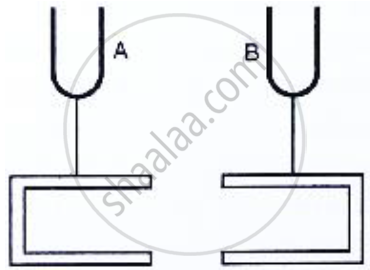
In following figure shows two tuning forks A and B of the same frequency mounted on two separate sound boxes with their open ends facing each other. The fork A is set into vibration.
- Describe your observation.
- State the principle illustrated by this experiment.
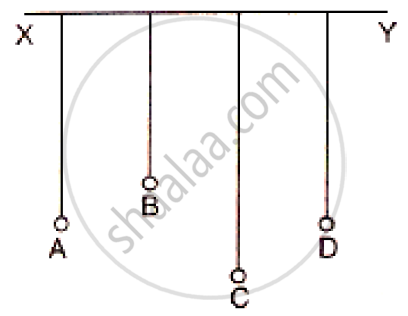
In following figure shows A, B, C and D are four pendulums suspended from the same elastic string XY. Lengths of pendulum A and D are equal, while the length of pendulum B is smaller and the pendulum C is longer. The pendulum A is set into vibration.
(a) what is your observation? (b) Give reason for your observation.
When a body vibrates under a periodic force, the vibrations of the body are ______.
Which characteristic of sound makes it possible to recognize a person by his voice without seeing him?
Two pendulums C and D are suspended from a wire as shown in the figure give below. Pendulum C is made to oscullate by displaying it from its mean position. It is seen that D also starts oscillating.
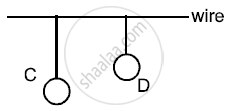
(i) Name the type of oscillation, C will execute.
(ii) Name the type of oscillation, D will execute.
(iii) If the length of D is made equal to C then what difference will you notice in the oscillations of D ?
(iv) What is the name of the phenomenon when the length of D is made equal to C ?
Give two examples of forced vibrations.
The rearview mirror of a motorbike starts vibrating violently at some particular speed of the motorbike, what could be done to stop the violent vibrations.
Explain why are soldiers asked to walk out of step while crossing bridges?
