Advertisements
Advertisements
प्रश्न
The rearview mirror of a motorbike starts vibrating violently at some particular speed of the motorbike, what could be done to stop the violent vibrations.
Advertisements
उत्तर १
This can be stopped by mounting the engine on such a structure, say steel springs that absorb the vibrations of the engine without communicating them to the frame and in this condition, the rearview mirror attached to the frame will not vibrate violently.
उत्तर २
(i) The frame of a motorcycle along with the rearview mirror is found to vibrate violently when it is driven to a particular speed. This happens when the frame has the natural frequency of vibration equal to that of the piston when the engine is driven at that particular speed.
(ii) This phenomenon is called ‘resonance’. In this phenomenon when a body begins with the natural frequency of the others vibrating body B, then A begins to vibrate violently with the maximum amplitude.
(iii) This can be stopped by mounting the engine on such a structure, say steel springs that absorb the vibrations of the engine without communicating them to the frame and in this condition, the rearview mirror attached to the frame will not vibrate violently.
संबंधित प्रश्न
In the diagram below, A, B, C, D are four pendulums suspended from the same elastic string PQ. The lengths of A and C are equal to each other, while the length of pendulum B is smaller than that of D. Pendulum A is set into a mode of vibrations.
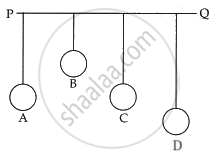
- Name the type of vibrations taking place in pendulums B and D.
- What is the state of pendulum C?
- State the reason for the type of vibrations in pendulums B and C.
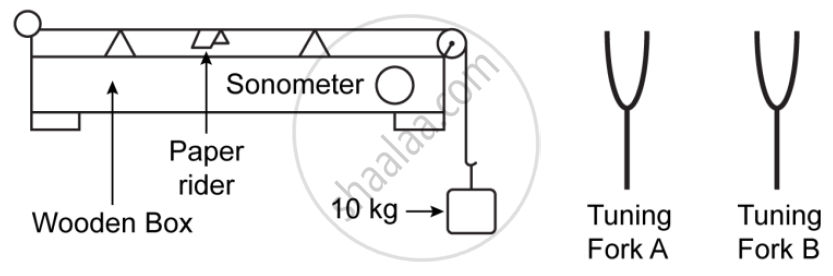
The diagram above shows a wire stretched over a sonometer. Stems of two vibrating tuning forks A and Bare touched to the wooden box of the sonometer. It is observed that the paper rider (a small piece of paper folded at the centre) present on the wire flies off when the stem of vibrating tuning fork B is touched to the wooden box but the paper just vibrates when the stem of vibrating tuning fork A is touched to the wooden box.
1) Name the phenomenon when the paper rider just vibrates.
2) Name the phenomenon when the paper rider flies off.
3) Why does the paper rider fly off when the stem of tuning fork B is touched to the box?
How does the medium affect the amplitude of free/natural vibrations of a body?
A vibrating tuning fork, held over an air column of a given length with its one end closed, produces a loud audible sound. Name the phenomenon responsible for it and explain the observation.
In following figure shows A, B , C and D represent test tube each of height 20 cm which are filled with water up to heights of 12 cm, 14 cm, 16cm and 18cm respectively. If a vibrating tuning fork is placed over the mouth if test tube D, a loud sound is heard.

- Describe the observations with the tubes A, B and C when the vibrating tuning fork is placed over the mouth of these tubes.
- Give the reason for your observation in each case.
- State the principle illustrated by the above experiment.
Explain why does the rear mirror of a motorbike start Vibrating Violently, at some particular speed of motorbike?
A string stretched between its ends is made to vibrate by placing the stem of a vibrating tuning fork at its one end. State three ways how you will increase the frequency of note produced by the string.
Explain Why are stringed musical instruments provided with large sound boxes?
