Advertisements
Advertisements
प्रश्न
A vibrating tuning fork, held over an air column of a given length with its one end closed, produces a loud audible sound. Name the phenomenon responsible for it and explain the observation.
Advertisements
उत्तर १
The phenomenon responsible for producing a loud audible sound is named resonance. The vibrating tuning fork causes the forced vibrations in the air column. For a certain length of air column, a loud sound is heard. This happens when the frequency of the air column becomes equal to the frequency of the tuning fork.
उत्तर २
Resonance describes the phenomenon. When the tuning fork frequency is 256 Hz, the loudness of a sound can be either 256 Hz or an integer multiple of 256. i.e., (256 × 1) Hz, (256 × 2) Hz, (256 × 3) Hz, ... or (256 × 5). In other words, the frequency of the tuning fork is 256 Hz, 512 Hz, 768 Hz or 1280 Hz.
APPEARS IN
संबंधित प्रश्न
Resonance is a special case of ______ vibrations, when frequency of the driving force is ______ natural frequency of the body.
Why is a loud sound heard at resonance?
How do you tune your radio set to a particular station ? Name the phenomenon involved in doing so and define it.
Name the phenomenon involved in tuning your radio set to a particular station and define it.
Differentiate between the following:
Radio waves and light waves.
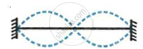
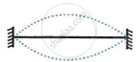
The diagram below shows three different modes of vibration P, Q and R of the same string of a given length.
 |
 |
 |
| P | Q | R |
- Which vibration will produce a louder sound and why?
- Which vibration will produce sound of maximum shrillness (or pitch) and why?
- What is the ratio of wavelength of vibrations P and R?
A bucket kept under a running tap is getting filled with water. A person sitting at a distance is able to get an idea when the bucket is about to be filled.
(i) What change takes place in the sound to give this idea?
(ii) What causes the change in the sound?
Explain why are soldiers asked to walk out of step while crossing bridges?
What do you understand by free vibrations of a body? Draw a displacement-time graph to represent them. Given one example.
