Advertisements
Advertisements
प्रश्न
A vibrating tuning fork, held over an air column of a given length with its one end closed, produces a loud audible sound. Name the phenomenon responsible for it and explain the observation.
Advertisements
उत्तर १
The phenomenon responsible for producing a loud audible sound is named resonance. The vibrating tuning fork causes the forced vibrations in the air column. For a certain length of air column, a loud sound is heard. This happens when the frequency of the air column becomes equal to the frequency of the tuning fork.
उत्तर २
Resonance describes the phenomenon. When the tuning fork frequency is 256 Hz, the loudness of a sound can be either 256 Hz or an integer multiple of 256. i.e., (256 × 1) Hz, (256 × 2) Hz, (256 × 3) Hz, ... or (256 × 5). In other words, the frequency of the tuning fork is 256 Hz, 512 Hz, 768 Hz or 1280 Hz.
APPEARS IN
संबंधित प्रश्न
Name the phenomenon involved in tunning a radio set to a particular station.
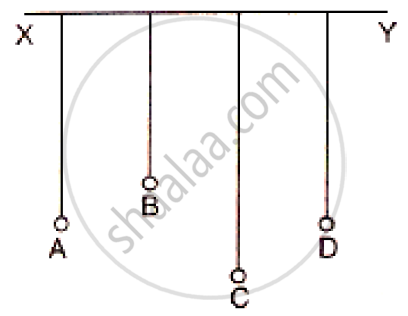
In following figure shows A, B, C and D are four pendulums suspended from the same elastic string XY. Lengths of pendulum A and D are equal, while the length of pendulum B is smaller and the pendulum C is longer. The pendulum A is set into vibration.
(a) what is your observation? (b) Give reason for your observation.
Two pendulums C and D are suspended from a wire as shown in the figure give below. Pendulum C is made to oscullate by displaying it from its mean position. It is seen that D also starts oscillating.
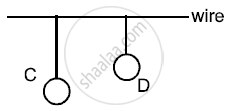
(i) Name the type of oscillation, C will execute.
(ii) Name the type of oscillation, D will execute.
(iii) If the length of D is made equal to C then what difference will you notice in the oscillations of D ?
(iv) What is the name of the phenomenon when the length of D is made equal to C ?
What do you mean by resonance? When does resonance occur?
Explain a tuning fork (vibrating) is held close to ear. One hears a faint sound. The same vibrating tuning fork is placed on table, such that its handle is in contact with table, one hears a loud sound.
A vibrating tuning fork is placed over the mouth of a burette filled with water. The tap is opened and the water level gradually falls. It is observed that the sound becomes the loudest for a particular length of the air column. What is the name of the phenomenon taking place when this happens? Why does the sound become the loudest?
When a tuning fork, struck by a rubber pad, is held over a length of the air column in a tube, it produces a loud sound for a fixed length of the air column. Name the above phenomenon. How does the frequency of the loud sound compare with that of the tuning fork? State the unit for measuring loudness.
What do you understand by forced vibrations?
What do you understand by free vibrations of a body? Draw a displacement-time graph to represent them. Given one example.
