Advertisements
Advertisements
प्रश्न
What are the factors that affect the frequency of a vibrating string and how do they affect the frequency?
Advertisements
उत्तर
The frequency (f) of a vibrating string is affected by:
(i) The length of the vibrating string. Frequency is inversely proportional to the length, i.e, `"f"α1/"l"`. it means, if length increases, frequency becomes less and if length decreases, frequency increases.
(ii) It is directly proportional to the square root of the tension, other factors remaining the same, e.g., if tension (or stretching force) is made 4 times, then the frequency will be `(sqrt4=2)` doubled.
(iii) The frequency, (f) is inversely proportional to the square root of the mass of unit length of the vibrating string, i.e., `"f"α1/sqrt"m′"` if m' is the mass of unit length of the string. Since m' = πr2.l, it shows that f is `α1/sqrt("r"^2)` or `1/"r"`, where r is the radius of the vibrating strings.
संबंधित प्रश्न
The adjacent diagram shows three different modes of vibrations P, Q and R of the same string.
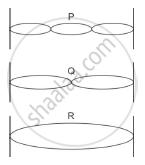
(i) Which vibration will produce a louder sound and why?
(ii) The sound of which string will have maximum shrillness?
(iii) State the ratio of wavelengths of P and R.
Give one example to illustrate forced vibrations.
Describe a simple experiment to illustrate the phenomenon of resonance and explain it.
A vibrating tuning fork, held over an air column of a given length with its one end closed, produces a loud audible sound. Name the phenomenon responsible for it and explain the observation.
On keeping the stem of a vibrating tuning fork on the surface of a table, a loud sound is heard. Give reason.
What do you mean by resonance? When does resonance occur?
The rearview mirror of a motorbike starts vibrating violently at some particular speed of the motorbike. What is the name of the phenomenon taking place? Why does the happen?
What do you understand by free vibrations of a body? Draw a displacement-time graph to represent them. Given one example.
Explain free and forced vibrations. Give an experimental arrangement to illustrate the phenomenon of resonance.
