Advertisements
Advertisements
प्रश्न
What are the factors that affect the frequency of a vibrating string and how do they affect the frequency?
Advertisements
उत्तर
The frequency (f) of a vibrating string is affected by:
(i) The length of the vibrating string. Frequency is inversely proportional to the length, i.e, `"f"α1/"l"`. it means, if length increases, frequency becomes less and if length decreases, frequency increases.
(ii) It is directly proportional to the square root of the tension, other factors remaining the same, e.g., if tension (or stretching force) is made 4 times, then the frequency will be `(sqrt4=2)` doubled.
(iii) The frequency, (f) is inversely proportional to the square root of the mass of unit length of the vibrating string, i.e., `"f"α1/sqrt"m′"` if m' is the mass of unit length of the string. Since m' = πr2.l, it shows that f is `α1/sqrt("r"^2)` or `1/"r"`, where r is the radius of the vibrating strings.
संबंधित प्रश्न
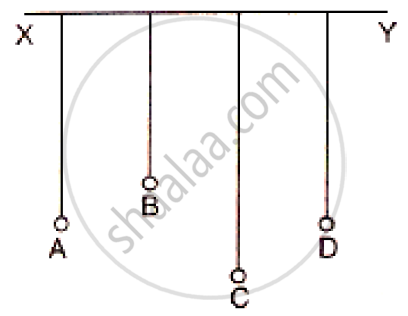
In following figure shows A, B, C and D are four pendulums suspended from the same elastic string XY. Lengths of pendulum A and D are equal, while the length of pendulum B is smaller and the pendulum C is longer. The pendulum A is set into vibration.
(a) what is your observation? (b) Give reason for your observation.
A vibrating tuning fork, held over an air column of a given length with its one end closed, produces a loud audible sound. Name the phenomenon responsible for it and explain the observation.
Which characteristic of sound makes it possible to recognize a person by his voice without seeing him?
Two pendulums C and D are suspended from a wire as shown in the figure give below. Pendulum C is made to oscullate by displaying it from its mean position. It is seen that D also starts oscillating.
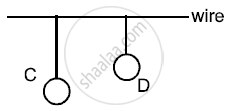
(i) Name the type of oscillation, C will execute.
(ii) Name the type of oscillation, D will execute.
(iii) If the length of D is made equal to C then what difference will you notice in the oscillations of D ?
(iv) What is the name of the phenomenon when the length of D is made equal to C ?
In fig. , P, Q, R and S represent test tubes each of height 20 cm which are filled with water upto heights of 10 cm, 14 cm, 16 cm and 18 cm respectively. If a vibrating tuning fork is placed over the mouth of test tube Q, a loud sound is heard.
(i) Describe the observations with the tubes P, R and S.
(ii) Give the reason for your observation in each case.
(iii) State the principle illustrated by the above experiment.

A bucket kept under a running tap is getting filled with water. A person sitting at a distance is able to get an idea when the bucket is about to be filled.
(i) What change takes place in the sound to give this idea?
(ii) What causes the change in the sound?
Explain why stringed musical instruments, like the guitar, are provided with a hollow box.
Describe a simple experiment to illustrate the phenomenon of resonance and explain it.
